Maryland Governor Faces Tough Challenge on Redistricting Ballot Question
Governor Wes Moore is expected to win re-election in November but faces a tough challenge on a ballot question that could significantly alter the state's congressional map.
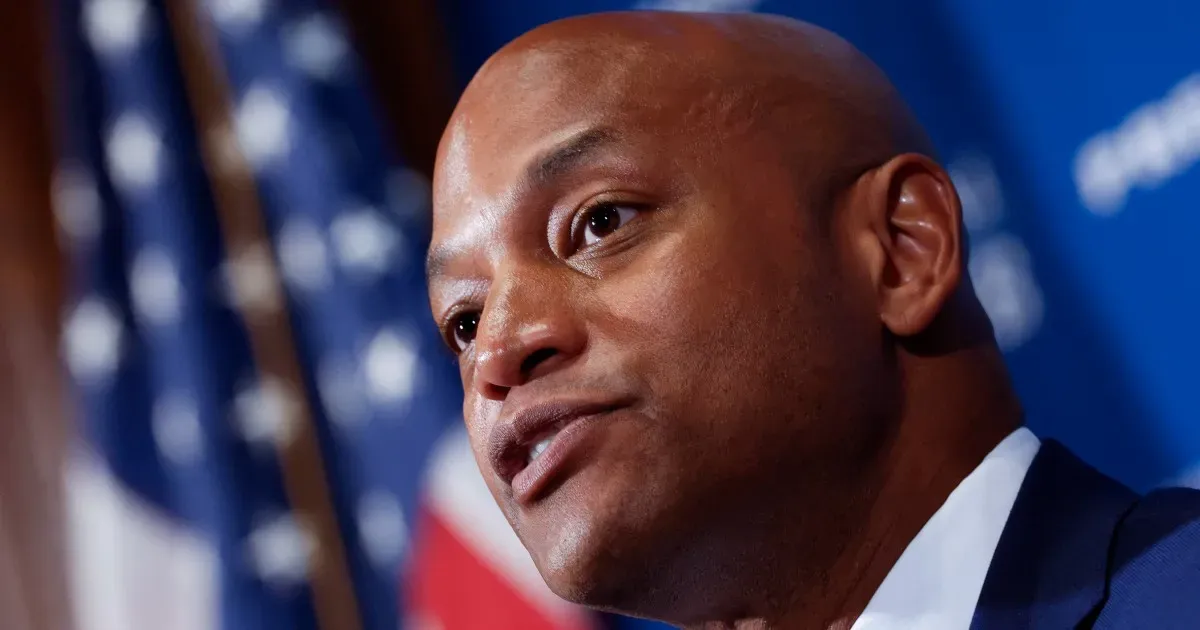
Maryland Governor Wes Moore is expected to win re-election in November, but he's not taking anything for granted as he faces a tough challenge on a ballot question that could significantly alter the state's congressional map.
The ballot question would give state Democratic leaders more control over redrawing district lines, potentially leading to an even more lopsided 8-0 map favoring Democrats. This move has sparked controversy and debate among Maryland voters, with some arguing it undermines the principles of fair representation.
Governor Moore and his allies are framing a vote for the ballot question as a way to resist Republican efforts to redraw district lines in their favor elsewhere. However, this argument may not be resonating with all voters, as recent weeks have shown that support for the measure is not as strong as initially thought.
A major effort has been launched to promote passage of the ballot measure, but it remains to be seen whether it will be enough to sway undecided voters and secure a majority. If the measure fails, it would deal a significant blow to Governor Moore's reputation and ambitions.
As speculation about his potential 2028 presidential campaign continues to grow, Governor Moore is under pressure to deliver on key issues like redistricting. His ability to navigate this challenge will be closely watched by observers both in Maryland and beyond.
The governor's own party has been divided on the issue, with some lawmakers opposing the move to redraw district lines. State Senate President Bill Ferguson, a fellow Democrat, recently blocked an effort to redraw the map, citing concerns about the lack of support among his colleagues.
Maryland's constitutional issue surrounding congressional district boundaries has been a contentious topic for years, dating back to 2021 when Democrats attempted to draw a more favorable map that was ultimately struck down by a state judge in 2022.
This setback led to the ballot measure currently facing voters, which seeks to address the underlying problem that sank the previous map. The measure aims to eliminate the requirement that Maryland's congressional districts follow natural boundaries, such as the Chesapeake Bay.
In August, lawmakers overwhelmingly moved to put this question before voters, despite reservations from some Democrats in the Legislature. The measure was rewritten by state judges after a legal challenge, allowing it to be placed on the ballot for consideration.
A recent poll conducted by the University of Maryland, Baltimore County found that a majority of likely Maryland voters (53%) plan to vote against the measure, with significant opposition coming from across party lines: 42% of Democrats, 74% of Republicans, and 59% of unaffiliated voters are all set to reject it.
According to Mileah Kromer, director of the UMBC Institute of Politics, the poll's results raise broader questions about democracy, particularly whether people prefer district lines that favor one party over another.
The reluctance of Maryland voters to support redrawn congressional district lines that favor Democrats stems from a desire to avoid using the same tactics employed by Republicans in other states.
Some Democrats may feel that co-opting this strategy would undermine their party's credibility and values. The fact that Democrats would only gain one seat in redistricting efforts also seems to be a contributing factor.
California, which passed a similar measure last year, was able to redraw congressional district lines in a way that gave Democrats an advantage in five seats. This move allowed the state to override its independent redistricting commission and adjust maps just months after Texas redrew its congressional maps to boost Republicans by an additional five seats.
The actions taken in California and Texas have set off a national fight over district lines, with multiple states engaging in redrawing their maps this year. Some red states succeeded in making changes, while others still face legal challenges.
A longtime Democratic strategist notes that Maryland voters are often well-informed about national politics, particularly those living in counties bordering Washington. This may contribute to the state's hesitation to support redrawn district lines.
The narrative around redistricting in Maryland has been dominated by concerns about partisan manipulation, but it seems this perception may not be entirely accurate.
Despite a recent UMBC survey indicating that many Democratic voters are concerned about the Trump administration and would respond positively to messaging opposing him, the groups backing and opposing Question 3 have only recently begun spending heavily on advertising.
The shift in focus from Moore's re-election campaign to supporting the ballot measure was evident when his team decided to switch advertising strategy last week.
This change is reflected in a significant increase in ad spending, with Fight Back MD investing $550,000 this month alone on TV ads urging voters to support Question 3.
Wes Moore's stance on redistricting has raised eyebrows among some observers, particularly given his lack of commitment to pursuing new congressional maps if Question 3 passes next month.
This ambivalence has apparently led to hesitation from certain donors who had expressed interest in supporting the redistricting campaign, according to an operative familiar with the pro-Question 3 effort.
The donor concerns stem from Moore's refusal to commit to passing new congressional maps during next year's legislative session, a stance that is being seen as a significant departure from his previous efforts on this issue.
Moore has been a strong supporter of redistricting in Maryland, and his absence from the current push has sparked speculation about his motivations for doing so.
Some have noted that Moore's out-of-state travel schedule has fueled rumors about potential presidential aspirations, although he has consistently denied these claims in recent years.
Moore's allies argue that a failed Question 3 vote would not necessarily be a liability for any future presidential aspirations.
A national Democratic strategist pointed out that voters outside of Maryland are unlikely to scrutinize Moore's record on redistricting.
This strategist believes that Moore has a strong track record on issues that matter most to the public, which could help mitigate any potential damage from a failed vote.
The strategist emphasized that a single issue like Question 3 should not be seen as a make-or-break moment for Moore's political ambitions.
Despite this optimism, Hanmer warned that opponents might use a failed Question 3 vote as an example of Moore's inability to deliver on key issues.
He predicted that redistricting could become a wedge issue between governors and other potential presidential candidates in the 2028 election.
Facts based on reporting originally published by NBC News Politics.
You may republish this story, in full or in part, if you credit News Central Site and link to it (licence CC BY 4.0). Photos are not included.