Kazakhstan's Kazakh Germans Share Stories of Deportation and Resilience
A young woman from Astana is part of a community that has been shaped by the Soviet regime's brutal deportations during World War II.
Yunna Kinereish is a young woman from Kazakhstan's modern capital, Astana, who identifies herself as a Kazakh German. She is one of 223,000 people in the Central Asian republic with German ethnicity. Kinereish is studying public relations and is involved in her community through the Wiedergeburt Association.
Kinereish recently took part in a play at the association's youth theater that told the story of her Russian German ancestors. She has strong connections to her family traditions and feels a sense of belonging to both Kazakh and German cultures. As she explains, "I am German by ethnicity, but I also feel that I'm Kazakh because I keep the traditions with my family, and I have this mentality."
The presence of Germans in Kazakhstan dates back to the 18th century when many were encouraged to leave Germany and settle in the Russian empire, particularly in Ukraine's Black Sea region. However, their fate took a dark turn during World War II when Stalin's Soviet regime started deporting hundreds of thousands of Germans living in Russia and Ukraine.
The deportations were a brutal consequence of Nazi Germany's invasion of the Soviet Union in 1941. Many innocent people who had no connection to the Nazi regime were collectively punished by the Soviet authorities, labeled as spies or collaborators. The number of deported individuals is staggering, over one million, with at least 200,000 losing their lives due to forced labor, hunger, and other harsh conditions.
The legacy of these events continues to shape the lives of Kazakh Germans today. Kinereish's story highlights the complexities of her community's history and its ongoing impact on their identity. As she navigates her studies and community involvement, she is also keeping alive the memories of her ancestors who faced unimaginable hardships during this period in history.
Yunna Kinereish's personal connection to the history of her people is palpable as she recounts the experiences of her ancestors who lived through a tumultuous period in Kazakhstan's past.
The stories shared by Yunna and her friends during their performances at the House of Friendship were emotionally charged, leaving a lasting impact on all involved. Despite the emotional toll, Yunna found the strength to present these accounts on stage with conviction.
Located in the capital city of Astana, the modern House of Friendship serves as a hub for German culture in the region. Funded primarily by the German government, this center offers language courses and engages in social work initiatives while fostering a culture of remembrance.
Yunna Kinereish's contributions to documenting her people's history extend beyond the stage. She has also been capturing their stories on film, with one notable project focusing on women who were imprisoned at ALZhIR.
The ALZhIR camp was part of the vast Soviet Gulag system established during Stalin's Great Terror campaign in the 1930s. This period saw the imprisonment of thousands of people deemed enemies of the state or traitors to the Motherland, including ethnic Germans.
Among those held captive at ALZhIR were 167 women who were incarcerated solely due to their husbands' convictions. Their stories are being told through Yunna's film project, shedding light on this dark chapter in history.
The city of Astana has undergone rapid transformation since it was designated as the capital in 1997. Its streets are now congested with traffic, a stark contrast to the barren steppe that lies just beyond its outskirts.
Astana's growth is evident in the numerous new buildings springing up along the city's periphery, but this expansion comes at the cost of pedestrian and cyclist-friendly infrastructure. The village of Akmol, located about an hour's drive from the city, offers a glimpse into the harsh realities faced by those living on the outskirts.
Before entering the ALZhIR museum, visitors are greeted by the imposing Arch of Grief, a steel monument paying tribute to the suffering and forced labor endured by women imprisoned in ALZhIR. The museum itself houses a collection of personal items once belonging to the female prisoners, including models of their cramped quarters and original documents.
One photograph on display is that of Gertrud Platais, a woman with German roots who was incarcerated for years at ALZhIR. Born in Lower Silesia, part of modern-day Poland, she had become a Soviet citizen after marrying Karl Eduard Platais.
Gertrud's husband was arrested during the Great Terror in 1938, and she too was convicted as a "relative of a traitor to the homeland." She was subsequently transferred to ALZhIR, where temperatures often soared above 40 degrees Celsius (104 degrees Fahrenheit) in summer and plummeted below -40 degrees Celsius in winter.
Gertrud's story is just one of many that sheds light on the terror inflicted by the Soviet system on Kazakh soil. Her experiences serve as a poignant reminder of the dark chapter in history that continues to leave its mark on the region.
The Karlag camp system is a haunting reminder of the Soviet Union's dark past. Spanning an area roughly 22 times the size of New York City, it was not just a prison camp but also a massive economic and agricultural complex that operated from 1931 to 1959.
During its operational years, approximately one million people passed through Karlag, with thousands more arriving each year. Conditions were harsh, and nearly 10,000 prisoners are believed to have perished between 1940 and 1950 alone due to starvation, exposure, illness, and the physical toll of forced labor.
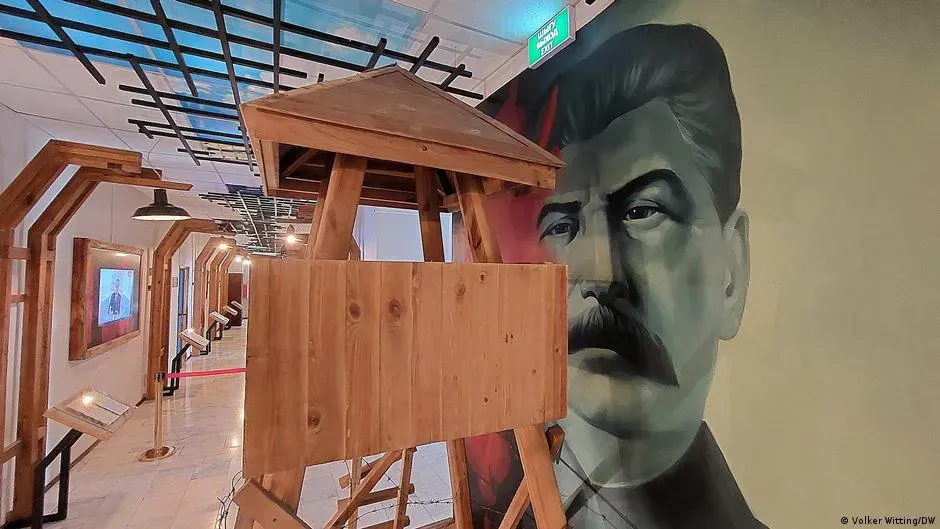
Located in the Kazakh steppe near Karaganda, about 250 kilometers south of Astana, the Karlag museum is situated within a former administrative building. This structure was used by camp officials, but it did not serve as a site for torture or interrogation.
Despite its somber purpose, the museum's layout and atmosphere have been criticized by visiting historians and specialists. The reconstruction of interrogation cells, accompanied by melodramatic music, creates an artificial and staged ambiance that detracts from the museum's intended impact.
The Karlag museum is not well-visited, with even educated young Kazakhs often unaware of its existence or significance. This lack of interest in confronting the country's brutal history is a concern shared by some experts, including American anthropologist Katherine M. Erdman, who has spent years researching the Gulag system and notes that many people in Kazakhstan and certain areas of politics have little desire to confront this aspect of their nation's past.
The researchers used a combination of modern technology and traditional methods to locate and document the sites of the former forced labor camps.
Their findings show that many regions in Kazakhstan have been shaped by the legacy of forced labor, with factories and housing developments constructed using bricks made by prisoners.
When Erdman and her team share their research with local communities, they often encounter a lack of interest or even outright rejection. At a time when the country is focused on economic and social progress, many people seem reluctant to confront the darker aspects of its past.
The Kazakh government's reluctance to engage with this aspect of its history may be due in part to a desire to present a more positive image to the international community. However, Erdman notes that there are still some individuals who are committed to preserving the memory of those who suffered during this period.
These efforts are being led by young people such as Yunna Kinereish, who is determined to ensure that her ancestors' experiences and sacrifices are not forgotten.
The legacy of the Soviet Union continues to impact ethnic Germans living in Kazakhstan, a country that was once part of the USSR. This reality is being addressed by initiatives aimed at preserving cultural heritage and promoting historical understanding.
These efforts are crucial for ensuring that the experiences of ethnic German ancestors are not forgotten, as they faced significant challenges during the Soviet era. Their struggles have left a lasting impact on the community to this day, with many seeking to learn from and honor their past.
Facts based on reporting originally published by DW English.
You may republish this story, in full or in part, if you credit News Central Site and link to it (licence CC BY 4.0). Photos are not included.