Harvard Researchers Achieve Coordinated Motion Among Diamond Spins
Researchers at Harvard University have successfully created coordinated motion among tiny magnets trapped within diamond's crystal lattice, known as nitrogen-vacancy (NV) centers, using interactions between randomly positioned spins to drive their behavior.
Researchers at Harvard University have made a groundbreaking discovery in the field of quantum sensing using diamond sensors. They have successfully created coordinated motion among tiny magnets trapped within diamond's crystal lattice, known as nitrogen-vacancy (NV) centers.
These NV centers are formed when a nitrogen atom is situated next to an empty gap where a carbon atom should be, giving them unique properties that allow them to behave like tiny magnets. This makes diamonds extremely sensitive detectors for magnetic fields, with potential applications in fields such as navigation and medical imaging.
However, achieving collective behavior among many spins has proven challenging due to the difficulty of precisely positioning or individually controlling each spin. To overcome this hurdle, scientists have been exploring ways to harness interactions between randomly positioned spins to drive coordinated motion.
A team led by Piotr Put at Harvard University has made a significant breakthrough in this area, publishing their findings in Physical Review X. They created coordinated motion within a 3D diamond sensor at room temperature, using the interactions between NV spins scattered at random to drive their behavior.
At room temperature, these interactions can be unpredictable and disruptive, causing the spins to quickly lose coordination with one another. Physicists have previously studied similar challenges in ultracold atoms and trapped ions, where they demonstrated that collective behavior can be leveraged for precise measurements.
Researchers have been exploring ways to harness the collective behavior of diamond's nitrogen-vacancy (NV) spin centers for precise measurements. To overcome challenges in previous experiments, Put's team turned to a different approach using thousands of NV spins in both thin diamond plates and narrow beams.
Each sample was mounted on a custom-designed chip that enabled the researchers to finely tune the magnetic field surrounding it. Lasers were used to align the spins in the same direction initially, followed by reading out their final states through careful timing.
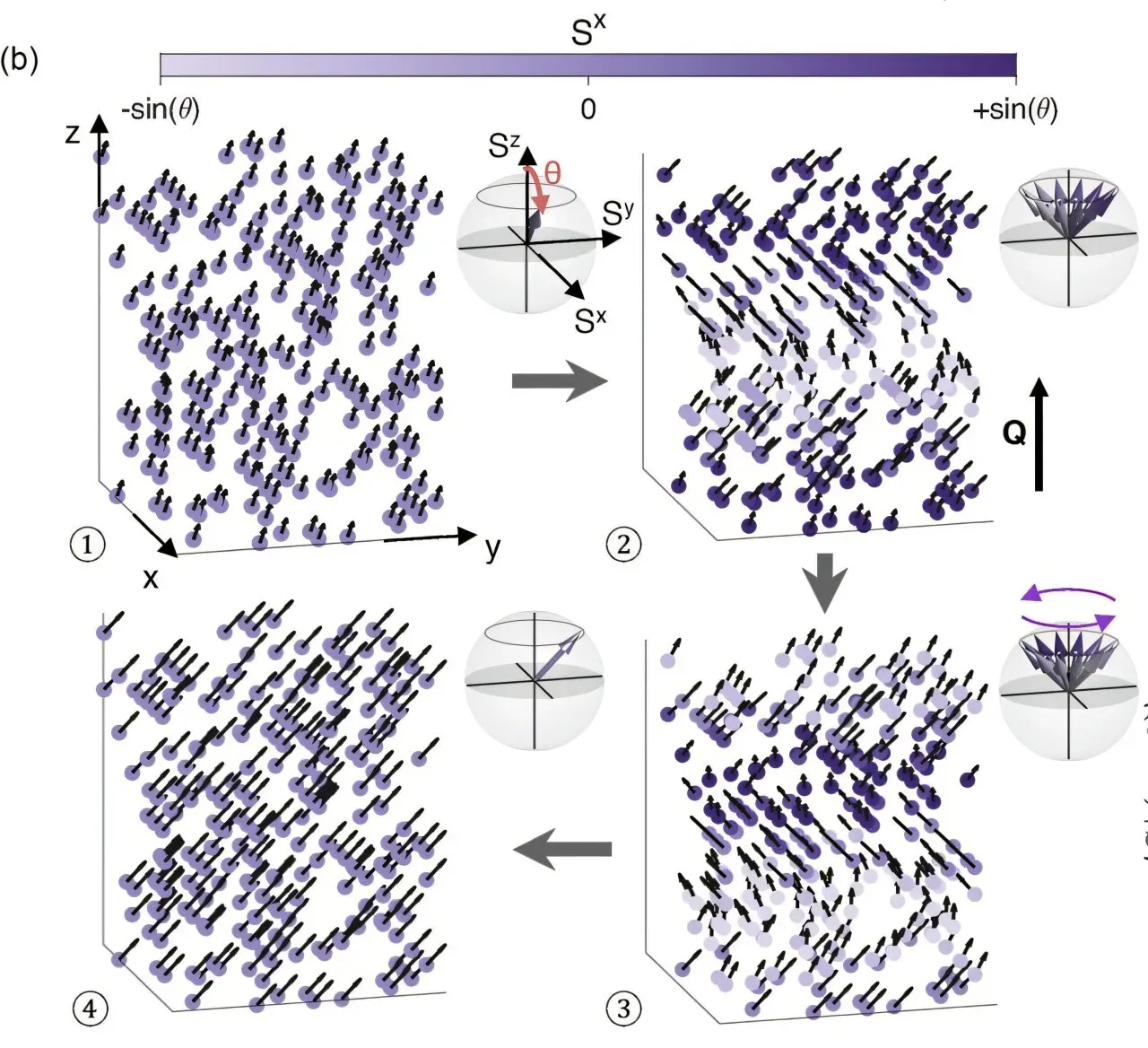
The team employed varying magnetic fields that formed spiral patterns in the spin directions and then unwound them again. Meanwhile, microwave pulses were applied at precise moments to alter how the NV spins interacted with each other. This intricate process was accompanied by nanoscale magnetic imaging and computer simulations to explain the observed motion.
Magnetic field gradients arranged the spins into spirals measuring just a few nanometers across. By strategically timing the microwave pulses, Put's team created a more balanced interaction between the spins, shielding them from disruption by strongly coupled pairs.
As a result of this carefully crafted setup, the coordinated motion of the NV spins developed more robustly before eventually fading away than it would have with their natural interactions alone.
The team's method allowed for a unique mapping of patterns within the spin ensemble at a resolution finer than 20 nanometers. This level of detail is crucial in understanding how the spins interact and influence one another. The researchers believe their approach could be used to create more accurate quantum measurements by reducing noise.
To achieve this, the technique must enable better readout of spin states and improve the stability of these states over time. According to the team's findings, this can lead to the creation of entanglement and "spin squeezing," a method that reduces uncertainty in one measurement at the expense of another. This could have significant implications for various applications.
The researchers are now planning to take their findings further by testing whether similar behavior can be replicated in larger spin ensembles. If successful, this could lead to the development of diamond sensors capable of amplifying weak magnetic signals. These sensors might eventually be used for nanoscale magnetic resonance imaging of materials and biological systems.
Such applications would require a deep understanding of how collective interactions within the spin ensemble affect the overall performance of these sensors. The team's next steps will involve exploring this relationship in greater detail, with the goal of refining their approach to meet the needs of emerging technologies.
The research team has now established a clear link between the spiraling spins and the emergence of coordinated quantum motion in diamond sensors. This breakthrough brings scientists closer to harnessing the full potential of these unique devices.
To refine their approach, the researchers will delve deeper into the intricacies of this relationship, with the ultimate goal of creating more efficient and reliable quantum sensors that can meet the demands of emerging technologies. The team's findings have significant implications for a range of applications, from precision medicine to advanced materials science.
Facts based on reporting originally published by Phys.org.
You may republish this story, in full or in part, if you credit News Central Site and link to it (licence CC BY 4.0). Photos are not included.