Gravity Linked to Quantum Information in Groundbreaking Discovery
Physicists have developed a new mathematical framework connecting spacetime curvature to quantum field information.
Gravity has been found to be linked to quantum information in a groundbreaking discovery that challenges our understanding of the fundamental forces of nature.
According to Einstein's theory of general relativity, gravity is a curvature of space and time caused by matter and energy. However, this theory has long been at odds with quantum mechanics, which describes the behavior of particles at the atomic and subatomic level. Researchers have struggled to merge these two theories into a coherent picture of reality.
In a major breakthrough, physicists have developed a new mathematical framework that connects the curvature of spacetime to the way information is stored in quantum fields. This innovative approach has shed light on the intricate relationship between gravity and quantum mechanics.
The researchers' work builds upon a seminal paper by Ted Jacobson, who demonstrated in 1995 that Einstein's equations can be derived from thermodynamics. This finding suggested that gravity might not be an inherent property of the universe but rather an emergent phenomenon arising from more fundamental principles.
Physicists have long sought to understand the origins of gravity and how it is connected to the quantum world. The new research provides a promising lead in this quest, using sophisticated mathematical techniques to link quantum information to spacetime geometry through the concept of quantum relative entropy.
A new mathematical framework has been developed to link quantum information with spacetime geometry, a long-standing goal in theoretical physics. The researchers have built on the idea that space and gravity may not be fundamental aspects of nature but could emerge from the quantum world.
Quantum relative entropy, a precise measure from quantum information theory, is being used instead of classical notions of entropy to describe how distinguishable two quantum states are. This quantity is essential in understanding the behavior of quantum systems and has been found to have a significant role in the study of black holes.
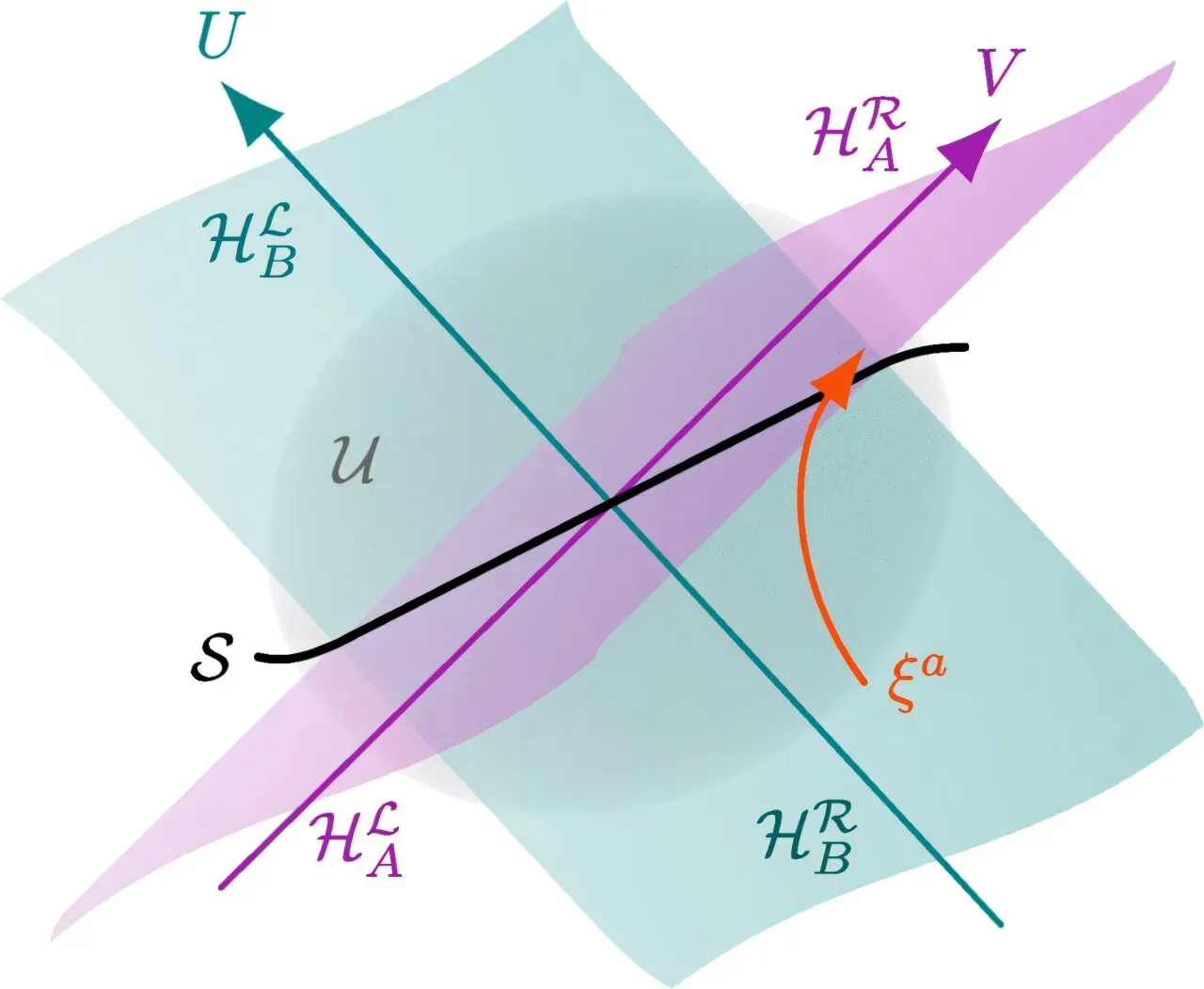
The connection between quantum information and gravity is being explored through the concept of relative entropy, which measures the distinguishability of two quantum states. The researchers have used this measure to derive a relationship between energy flowing across a horizon and the value of relative entropy at that horizon.
Horizons are boundaries in spacetime beyond which no information can be received, and the flow of energy across them is an important aspect of black hole behavior. The relationship between entropy and the area of horizons has been well established by previous research, and this new connection provides a deeper understanding of the interplay between quantum matter and spacetime.
The significance of these findings lies in the novel proof that establishes the link between information and gravity. While some fundamental ingredients were already known, this work provides a fresh perspective on the relationship between quantum systems and spacetime geometry.
The connection between entropy and gravity has long been understood through analogies with classical thermodynamics. However, researchers have now made significant progress in establishing a rigorous mathematical framework for this relationship. They argue that the precise quantum notion of information can take its place in understanding the connection.
According to the study, the derivation uses mathematically rigorous and well-defined quantities to replace earlier heuristic arguments. This approach supports the view that spacetime and gravity may emerge from more fundamental quantum information. The researchers see this as a crucial step toward developing a theory of quantum gravity.
The research suggests that gravity is fundamentally rooted in quantum information. The curvature of space and time may be governed by how quantum states can be distinguished from one another. This idea has far-reaching implications for our understanding of the universe, particularly in relation to quantum mechanics.
Quantum field theory in curved spacetime is often seen as a starting point for developing a theory of quantum gravity. However, the findings suggest that this approach hints at a more fundamental relationship between local spacetime curvature and quantum information. The study's authors propose that Einstein's equations can be obtained from quantum information.
In essence, the research proposes that matter can be thought of as plucking a guitar string, with spacetime being the string itself. The note produced by this interaction is akin to Einstein's equations, which describe the fundamental laws governing gravity. This analogy highlights the intricate connection between quantum mechanics and general relativity.
Physicists have been studying how quantum matter behaves near cosmic boundaries, such as those surrounding black holes, for decades. They've also explored the thermal properties of empty space, which is a fundamental aspect of understanding the universe.
Recent breakthroughs in relative entropy have provided the crucial link between quantum information, thermodynamics, and gravity. This connection has been a long-standing puzzle in modern physics, with far-reaching implications for our understanding of the cosmos.
The research has significant potential to deepen our knowledge of the underlying laws governing nature. Historically, foundational work like this has often had profound long-term consequences. General relativity, once considered a purely theoretical framework, is now essential to technologies such as GPS navigation systems.
Quantum information, which underlies quantum computing and other emerging technologies, is also at the heart of this research. If confirmed and further developed, the findings could help bridge the significant gap between our understanding of the microscopic world and Einstein's theory of gravity.
The researchers behind this study have chosen not to treat gravity as a fundamental force in its own right, instead exploring the idea that spacetime may emerge from the quantum universe's informational structure.
Their work suggests that spacetime could be a product of the underlying quantum world, rather than a standalone entity with its own set of rules. This notion is closely tied to the concept of emergent gravity, which proposes that gravity arises from more fundamental aspects of reality.
To further validate their findings, the researchers plan to expand their investigation to encompass various forms of quantum matter and lightlike surfaces, both of which play critical roles in black hole physics. By doing so, they aim to shed more light on the intricate relationship between spacetime and quantum information.
The team's ultimate goal is to derive gravity solely from quantum information, a feat that could potentially provide valuable insights into the development of a complete theory of quantum gravity. To achieve this, they will need to formulate the quantum component of their equations and observe whether the resulting solution aligns with Einstein's theory of gravity.
The researchers' goal is to formulate the quantum component of their equations, a crucial step in understanding how gravity and quantum information are connected. This involves developing a mathematical framework that can reconcile the principles of quantum mechanics with Einstein's theory of general relativity.
To achieve this, they will need to observe whether the resulting solution aligns with Einstein's theory of gravity. The outcome could have significant implications for our understanding of the universe and the behavior of matter at its most fundamental level. If successful, their work may shed new light on the long-standing puzzle of quantum gravity.
Facts based on reporting originally published by Phys.org.
You may republish this story, in full or in part, if you credit News Central Site and link to it (licence CC BY 4.0). Photos are not included.