George Lucas Museum Opens in Los Angeles
The George Lucas Museum of Narrative Art is a 300,000-square-foot structure designed by Ma Yansong of MAD architects.
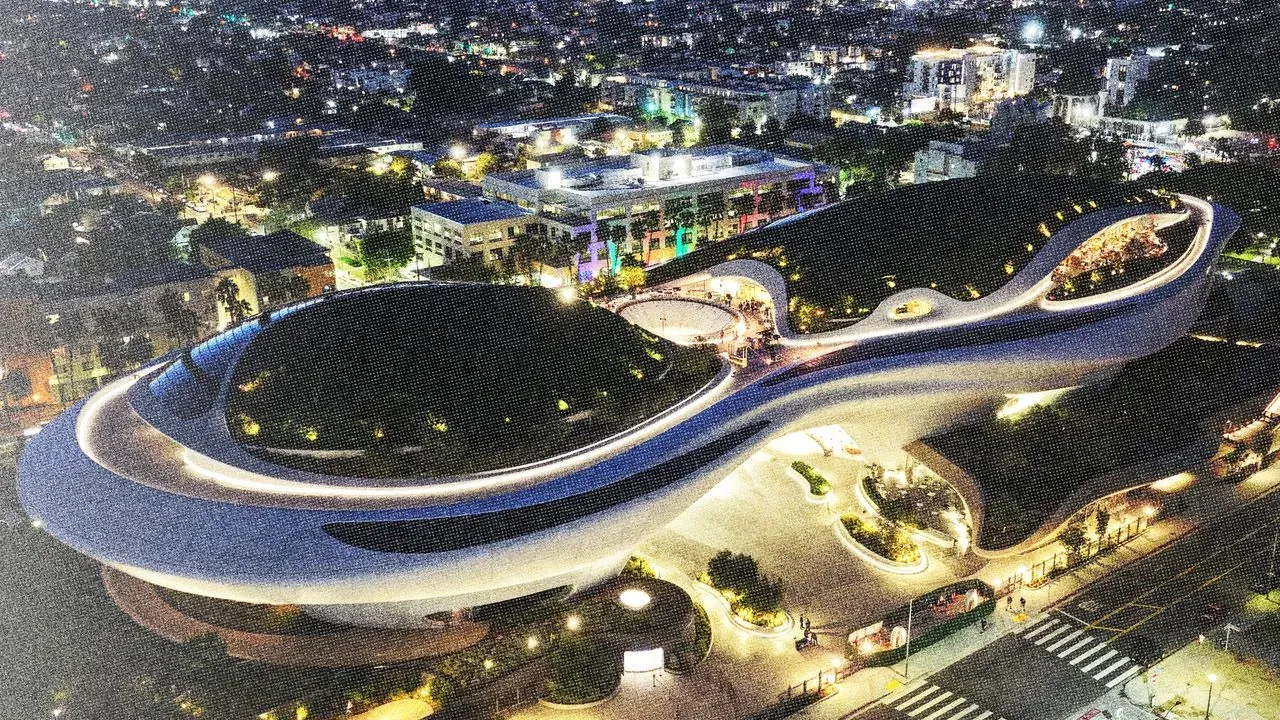
A new museum dedicated to the works of film director George Lucas has opened in Los Angeles, marking a significant addition to the city's cultural landscape.
The 300,000-square-foot structure, designed by Ma Yansong of MAD architects, boasts an unconventional design that blends futuristic and Art Deco elements. The building's rounded edges and biomorphic shape evoke a sense of fluidity, with its vast roof landscaped with native grasses and wildflowers.
Located in Exposition Park just south of Downtown Los Angeles, the museum is situated across the street from Lucas's alma mater, the University of Southern California. The massive structure houses a substantial collection of artworks from Lucas and his partner Mellody Hobson, who have amassed over 40,000 pieces.
The museum's design and layout aim to create an immersive experience for visitors, with features such as glass pneumatic elevator tubes that transport guests to the fourth-floor galleries. Staff members wear snappy uniforms, adding to the overall sense of spectacle.
As one enters the museum, they are immediately immersed in a world of storytelling art, with murals, manga, props, and costumes on display. The vast collection includes an array of artifacts from Lucas's film career, setting the stage for what promises to be a fascinating exploration of his creative vision.
The museum's design is a deliberate attempt to create an immersive experience for visitors.
Its two theaters are expansive spaces that evoke a sense of grandeur and wonder.
One can imagine being transported into the world of Star Wars as one sits in these vast auditoriums.
Meanwhile, the view from the Skywalker Grill offers breathtaking vistas of the city below.
The museum's overall aesthetic is sleek and sophisticated, with no hint of kitsch or tackiness.
However, this contrast between high art and popular culture is intentional, reflecting Lucas's fascination with mythic archetypes.
These universal themes are woven throughout his films, which often draw upon ancient myths and legends.
Lucas believes that even the most seemingly lowbrow art forms can contain deep meaning and significance.
This approach has led to galleries dedicated to artists like Norman Rockwell and Maxfield Parish, whose work is celebrated for its nostalgic charm.
The museum's collection extends far beyond traditional fine art, incorporating a wide range of eclectic items that are often overlooked by mainstream museums.
This approach has led to galleries dedicated to artists who have made significant contributions in various mediums.
Original items from the Lucas collection are juxtaposed with high-definition reproductions and projections, creating an immersive experience for visitors.
The winding environment is designed to transport viewers through thousands of years of storytelling, showcasing a diverse range of artistic expressions.
The George Lucas Museum's focus on everyday art and storytelling is a refreshing departure from traditional fine-art museums, which often prioritize prestige over popular culture.
One notable example of this dichotomy is the 1991 "High and Low: Modern Art and Popular Culture" exhibition at the New York Museum of Modern Art, where comic-book genius R. Crumb was showcased alongside pop masters Roy Lichtenstein and Andy Warhol.
This blending of high and low art has been explored in various exhibitions over the years, including "A. Art in the 1990s, a showcase that celebrated artists like Mike Kelley, Paul McCarthy, and Raymond Pettibone, who all deal with pulp and popular culture in their work.
Museums often struggle to balance their desire for artistic prestige with the need to engage with the public, leading many to exclude everyday art and popular culture from their exhibitions. The Lucas Museum's focus on vernacular storytelling may be seen as a challenge to these traditional boundaries.
This raises questions about what constitutes real art: is it high-brow or low-brow? Is it created for private collectors or for the public to enjoy? And does the Lucas Museum's unconventional approach stray too far from established artistic canons?
The George Lucas Museum's commitment to inclusivity is evident in its extensive collection of artworks that challenge social norms and critique capitalism. One notable example is the acquisition of Judy Baca's The History of California mural archive, which provides a comprehensive visual representation of the artist's nearly one-mile-long work.
This monumental piece, often referred to as The Great Wall of Los Angeles, features a scrolling video showcasing working-class struggles, marginalized communities, and political dissidents. The artwork blends social realism with science fiction elements, depicting scenes that include images of inner and outer space.
Lucas's affinity for this type of art is not surprising, given his own franchise's anti-imperialist themes. The Star Wars series has consistently featured clunky yet righteous critiques of power imbalances, which are echoed in the museum's collection.
The museum's galleries are filled with artworks that cater to diverse tastes and interests, from the Star Wars in Motion installation featuring full-scale replicas of iconic vehicles to the broader range of art pieces on display. The presence of fans from various age groups and linguistic backgrounds adds a lively atmosphere to the space.
In this context, it becomes clear that Lucas's approach to curation is not about creating a pop-culture cathedral but rather about celebrating art that challenges conventions and pushes boundaries.
The George Lucas Museum's unconventional approach to curation has been met with skepticism by some in the art world. However, this critique overlooks the museum's potential to challenge and subvert traditional notions of what constitutes high" art.
Lucas and his team have made a deliberate effort to showcase artists who often fall outside the mainstream art canon. By doing so, they are creating a space that celebrates kitsch and challenges the conventions of contemporary art. The inclusion of comix covers by Robert Crumb is a prime example of this approach.
The museum's collection also extends beyond traditional mediums, incorporating video art and installation pieces that explore American archetypes through satire. Artists such as María Berrío, Daisy Holden, and Petra Cortright are featured alongside Crumb, creating a diverse and eclectic mix of styles and themes.
Ultimately, the George Lucas Museum's mission to give voice to underrepresented artists may signal a shift in how we think about art and its place in society.
Facts based on reporting originally published by GQ.
You may republish this story, in full or in part, if you credit News Central Site and link to it (licence CC BY 4.0). Photos are not included.