Federal Reserve Chair Kevin Warsh Sends Mixed Signals on Monetary Policy
The Federal Reserve chair has been sending mixed signals about his stance on monetary policy since taking office as President Donald Trump's handpicked chairman.
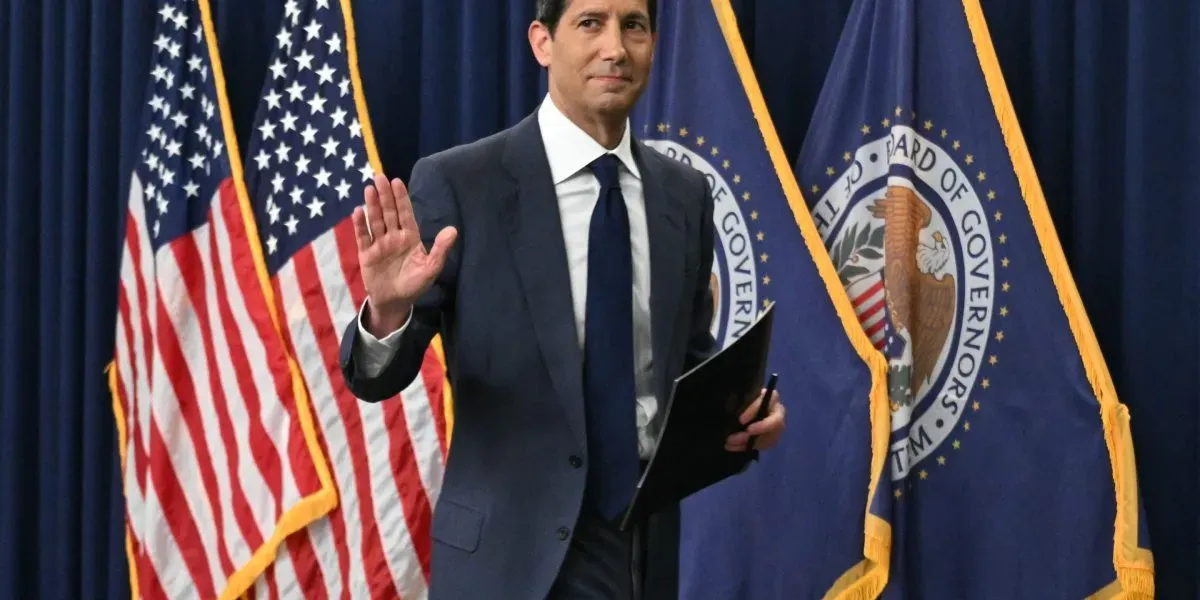
The Federal Reserve's chair, Kevin Warsh, has been sending mixed signals about his stance on monetary policy since taking office as President Donald Trump's handpicked chairman. Initially, many expected him to adopt a more relaxed approach to interest rates, but he surprised analysts by declaring that inflation is "a choice," indicating a tougher line.
This ambiguity has continued throughout the summer, with Warsh suggesting that alternative inflation gauges be used and implying that the bond market would help tighten monetary policy. However, his hawkish tone at the Jackson Hole conference in August raised eyebrows among investors. The Fed subsequently hiked interest rates unanimously in September.
Warsh's latest move was to hold back on another rate hike despite rising inflation, sparking confusion about his intentions. His decision was met with a lack of explanation and no hint about future policy decisions, which some interpreted as a dovish stance. However, this interpretation may be misguided, according to economist Robin Brooks.
Brooks, a senior fellow at the Brookings Institution, argues that Warsh's actions are not driven by a desire to control inflation or stimulate growth, but rather by concerns over the US debt picture. In a recent post on Substack, Brooks wrote that Warsh is focused on managing yield curves due to the precarious state of the country's finances.
According to Brooks, the hot inflation readings do not justify Warsh's statements, which seem to contradict his dovish appearance last week. Instead, the Fed chair is working to balance competing priorities, including managing debt costs, which may soon threaten GDP growth if interest rates continue to rise.
The surge in Treasury yields this year has significant implications for the US economy, particularly when it comes to managing its burgeoning national debt. The country's debt levels are already alarming, exceeding $40 trillion in gross terms and accounting for a staggering 100% of GDP.
In recent years, the federal government's debt-interest costs have skyrocketed, eclipsing even defense spending. In fact, fiscal year 2026 saw these costs top $1 trillion, making it clear that managing debt is a pressing concern for policymakers.
According to economist Brooks, inflation and other macroeconomic data take a backseat in the Fed's priorities. Instead, he believes the central bank is focused on stabilizing long-term yields. This assessment is supported by recent actions taken by Treasury Secretary Scott Bessent, who has intervened in the bond market to keep borrowing costs under control.
Bessent's surprise announcement to purchase more long-term bonds was a notable move, one that briefly lowered yields and provided some relief for investors. Furthermore, his decision to prop up the yen without prompting Japan to sell its US debt holdings also suggests a coordinated effort between the Fed and Treasury Department to manage bond yields.
However, these efforts may not be entirely effective in the face of rising oil prices and inflation expectations driven by fears of an Iran war re-escalation. Additionally, concerns about the AI boom's sustainability have taken some pressure off yields, while France's economic woes have sparked worries about a potential debt crisis spreading throughout the eurozone.
The US Treasury market has seen a shift in investor sentiment, with many now viewing government debt as a safe-haven asset again. This change is reflected in the 10-year yield, which has dipped below 5% once more.
Economist Brooks argues that Federal Reserve Chairman Kevin Warsh's approach to managing long-term yields is not driven by inflation concerns, but rather a desire to keep borrowing costs manageable. By doing so, Warsh may inadvertently be paving the way for fiscal dominance in the US economy.
Fiscal dominance occurs when high debt and deficits erode the Fed's ability to independently control monetary policy and combat inflation. This situation can arise if nominal GDP growth fails to keep pace with interest rates, leading to a vicious cycle where borrowing costs outstrip economic expansion.
Recent bond yield increases have far exceeded long-term projections, sparking concerns about the trajectory of US debt. The Congressional Budget Office has modeled scenarios based on yields 150 and 50 basis points higher than its baseline estimate of 4.3%.
The Congressional Budget Office's baseline estimate of a 4.3% interest rate on government debt may soon be surpassed by actual yields.
Analysts at Bank of America have analyzed the CBO's numbers and predict that the effective interest rate on government debt could exceed long-term nominal GDP growth as early as fiscal year 2028, which begins in October 2027.
Nominal growth remains robust for now, with a 5.6% pace in the third quarter driven by the AI boom and high inflation, but this may not be sustainable unless AI adoption leads to substantial productivity gains.
Facts based on reporting originally published by Fortune.
You may republish this story, in full or in part, if you credit News Central Site and link to it (licence CC BY 4.0). Photos are not included.