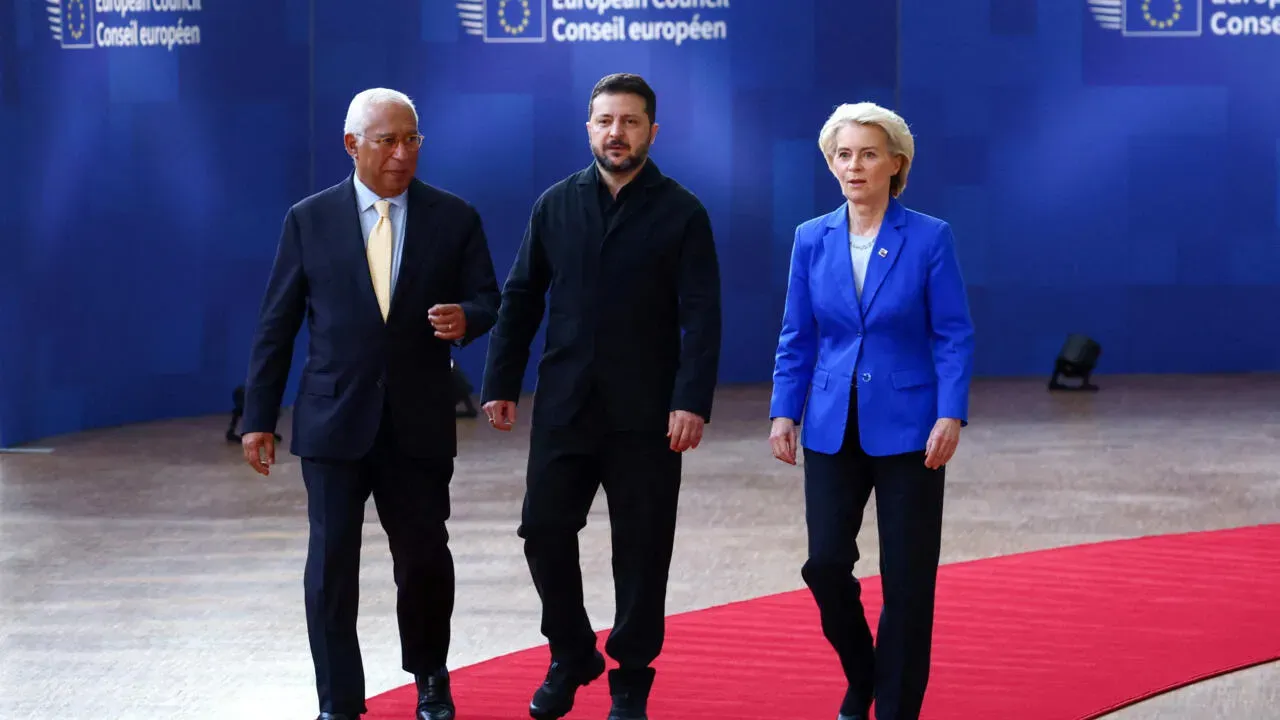
European Union leaders convene for high-stakes meeting on joint budget
EU leaders are set to discuss a proposed €45 billion loan to support Ukraine through 2027 as part of their long-term budget.

European Union leaders are set to convene in Brussels for a high-stakes meeting that promises to expose deep divisions within the bloc. The gathering is expected to focus on the EU's long-term budget, which includes a proposed €45 billion loan to support Ukraine through 2027.
The new joint budget is designed to reflect the EU's ambitions and influence on the world stage. Funding will be allocated based on each member country's economic size, with contributions ranging from 1% to 1.2% of the bloc's gross national income over the 2028-2034 period.
European Council President António Costa has called for an agreement, emphasizing that leaders have a responsibility to find a balanced solution. In a summit invitation letter, he urged members to "reach an agreement and tabled a new proposal last weekend that cuts about 10% off the original European Commission plan.
Costa will chair the two-day meeting in Brussels, where EU leaders will grapple with complex issues. The negotiations are complicated by upcoming elections in several key member countries, including France, Italy, Poland, and Spain.
The polls in these countries are expected to have a significant impact on the budget talks, as new governments may emerge with fresh priorities that could further complicate the agreement process. In particular, the results of Sunday's election in Spain will add to the uncertainty surrounding the negotiations.
As leaders gather for the meeting, they face a tight deadline: any deal reached must be finalized by the end of next month to avoid delaying matters further. The pressure is on EU leaders to find common ground and reach an agreement that addresses the bloc's long-term challenges.
The EU's budget negotiations have become increasingly polarized, with some member states digging in their heels over funding allocations.
Germany and its allies are leading the charge against increased contributions, insisting that belt-tightening measures be implemented to offset additional costs.
These countries argue that they already pay more into the EU pot than they receive back in allocations, making them net contributors to the bloc's budget.
The friends of cohesion group, comprising France and Italy among others, is fiercely defending funds that support farmers and infrastructure projects in poorer member states.
This faction believes that these initiatives are crucial for bringing all EU countries up to par with each other.
EU leaders are grappling with a complex budget puzzle that includes Ukraine's financial needs. A significant portion of the spending package is allocated to Ukraine, with a proposed 100 billion-euro envelope over seven years. This amount would cover various expenses, including 20 billion euros for the economy and 25 billion euros for the armed forces.
The proposal to raise funds through an EU-wide tax on digital services has been put forward by Costa as a potential solution. The tax would target online advertising revenue and money generated from user data, potentially generating 5 billion euros annually. This revenue could be used to support Ukraine's financial needs.
German Chancellor Friedrich Merz has emphasized the importance of collective commitment to Ukraine. He threatened to hold up budget agreement negotiations if all member countries did not make a collective commitment" to supporting Ukraine without exception. Merz highlighted that helping Ukraine is crucial for indivisible European security and must be accompanied by burden-sharing for support.
Bulgaria, the Czech Republic, Hungary, and Slovakia are among those opposing the use of funds for military aid to Ukraine. In a letter to Costa, Merz reiterated the significance of Ukraine's financial needs due to Russia's intensified attacks on energy and civilian infrastructure. These disruptions have strained Ukraine's finances, making it increasingly difficult for the country to meet its expenses.
The EU commission plans to raise money for the loans on capital markets once again. A total of 45 billion euros is earmarked for a new loan for Ukraine, in addition to the existing 90 billion-euro loan endorsed nearly a year ago.
EU leaders are expected to engage in intense negotiations over Ukraine funding at their upcoming meeting, with Commission President Costa set to present his proposal for additional financial support. In a bid to facilitate discussions, he plans to divide the leaders into smaller groups for bilateral talks, sharing his conclusions with all 27 member states afterwards.
Despite expectations that an agreement may not be reached this time around, EU diplomats suggest that a deal is more likely to materialize at the next month's meeting. Furthermore, missing the December deadline does not necessarily imply that funding will cease entirely, as nations have until January 2028 to adopt and approve legislation governing spending programs.
Facts based on reporting originally published by France 24 English.
You may republish this story, in full or in part, if you credit News Central Site and link to it (licence CC BY 4.0). Photos are not included.