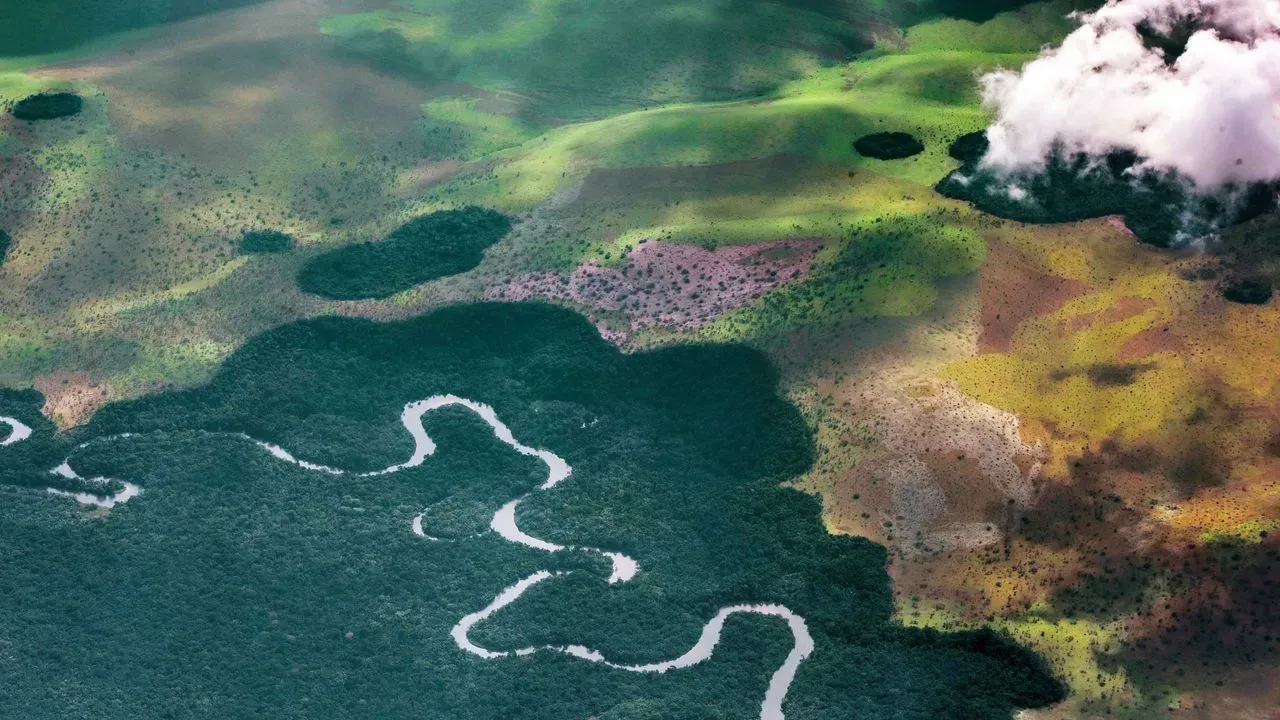
Congo Basin Receives Limited Scientific Research Funding and Conservation Support
A Welsh extreme athlete is currently paddling down the 400-mile stretch of the Sangha River in a state-of-the-art inflatable boat, documenting his journey on social media.

The Congo Basin has long been shrouded in mystery, captivating the imagination of many with its dense forests and winding rivers.
Covering a vast area roughly equivalent to the size of India, this Central African region is home to over 150 distinct ethnic groups and boasts an astonishing array of biodiversity.
Despite its immense importance as a carbon sink and counterbalance to climate change, the Congo Basin receives alarmingly little scientific research funding and conservation support.
Visitors have been drawn to the region for centuries, seeking fortune, adventure, and glory in the midst of its vast expanse.
The Sangha River, a tributary of the mighty Congo River, has become the latest destination for thrill-seekers and adventurers. Ash Dykes, a Welsh extreme athlete, is currently paddling down its 400-mile stretch in a state-of-the-art inflatable boat. By mid-October, he had already covered half of his intended journey, leaving many to wonder about the challenges he faces along the way.
However, Dykes' videos documenting his journey have been met with a healthy dose of skepticism by those familiar with the region. While they may be entertaining and suspenseful, they are not entirely accurate. Locals, paddling their wooden pirogues with ease, often come across as more competent than Dykes in his high-tech vessel.
In fact, many of the experiences that Dykes claims to have had during his journey can be easily replicated by anyone willing to take on the challenge. Attending a hunt with the Ba'aka people or tracking Western lowland gorillas are just a few examples of activities that do not require exceptional bravery or skill.
As I watched Dykes' videos, I couldn't help but feel a sense of enchantment with the Congo Basin and its vast, mysterious landscape. The idea of traveling along its rivers and into its forests is certainly alluring, especially at dusk when the sounds of the forest take on a primal quality, like the beat of a pounding drum in the distance.
The Princesse Ngalessa, a multi-level riverboat operated by Ducret Expeditions, set sail from Brazzaville, the capital of the Republic of Congo. This journey marked a unique experience for the crew, who are accustomed to receiving admiring glances from the riverbank as they navigate through the Congo Basin.
However, their arrival was often met with excitement and anticipation from the villagers, who saw the ship's presence as an event in itself. The Ngalessa brought not only goods but also community support and news from afar, making it a welcome sight in these rural areas. In stark contrast to the crowded and polluting daka-dakas that travel between Kinshasa and Kisangani, the Ngalessa offered its passengers a luxurious experience with air-conditioning, three meals a day, and private bathrooms.
As we traveled along the river, our local guides proved invaluable in navigating the cultural nuances of each village. They were fluent in the various languages spoken by the communities and had a deep understanding of their customs and traditions. This expertise allowed us to immerse ourselves fully in the local way of life, from watching an Ejengi forest spirit dance in Ngabe to observing an Indigenous Luma woman prepare medicinal pain relief from twigs.
Our guides also provided reassurance when needed, such as when we encountered a forest spirit, assuring us that there was no cause for concern.
Our day began with a leisurely paddle through the Alima River's flooded forests, where we encountered fishermen in their small pirogues exchanging goods for smoked fish and fruit with our ship's crew.
After eight days and 600 miles of navigating the Congo's waters, we finally arrived at the outpost of Ouesso on the Sangha River, marking a significant milestone in our journey.
A launch boat took me further into the Central African Republic, where I spent several days at Sangha Lodge. It was there that I met Rod Cassidy, an eco-tourism pioneer who has dedicated years to working with the local Ba'aka people.
During my time at Sangha Lodge, I had the privilege of joining a hunt with the Ba'aka, watching them expertly use their homemade nets to catch a duiker.
The Congo Basin has a unique quality that sets it apart from other destinations. Its raw and atavistic nature makes it an ideal place for great adventures to unfold. However, this does not mean it's a "heart of darkness" as some might perceive it.
Watching the Ba'aka people in action is a humbling experience. Their ability to live off the land, using their homemade nets to catch prey, is a testament to their resourcefulness and connection with nature. The women's chipped fangs, used as a show of strength, are a fascinating aspect of their culture.
The Congo Basin's independence is what truly separates it from other places. Unlike many destinations that require protection and provisions for visitors, this region stands out in its ability to sustain itself without external support. Its people have learned to live off the land, relying on the forest and waters for their survival.
One of the most striking aspects of the Congo Basin is the way its inhabitants interact with each other. They exude a sense of happiness and contentment that's hard to find elsewhere. Their laughter and chatter are infectious, and it's clear that they've found a deep connection with one another and with nature.
As the Ngalessa continued its journey northward, the sky transformed into a dramatic display of nature's power, with clouds gathering in thick clusters that soon unleashed a torrential downpour. The storm was brief but intense, and when it finally passed, the sun broke through the clouds once more, casting a warm glow over the landscape.
The scent of damp earth filled the air as the forest came alive with the sounds of nature, including a distant patter of drumming that echoed through the trees before fading into the distance. It was a moment to be savored, and I couldn't help but feel grateful for this experience as the dinner bell rang out, a reminder that even in the midst of adventure, life's simple pleasures are still to be enjoyed.
Facts based on reporting originally published by Conde Nast Traveler.
You may republish this story, in full or in part, if you credit News Central Site and link to it (licence CC BY 4.0). Photos are not included.