Bijan Mortazavi Returns to Iran After 47 Years Abroad
Iranian musician Bijan Mortazavi has returned to his homeland after 47 years abroad, marking a significant moment for the country's music scene. His return is expected to have a substantial impact on the local music industry.
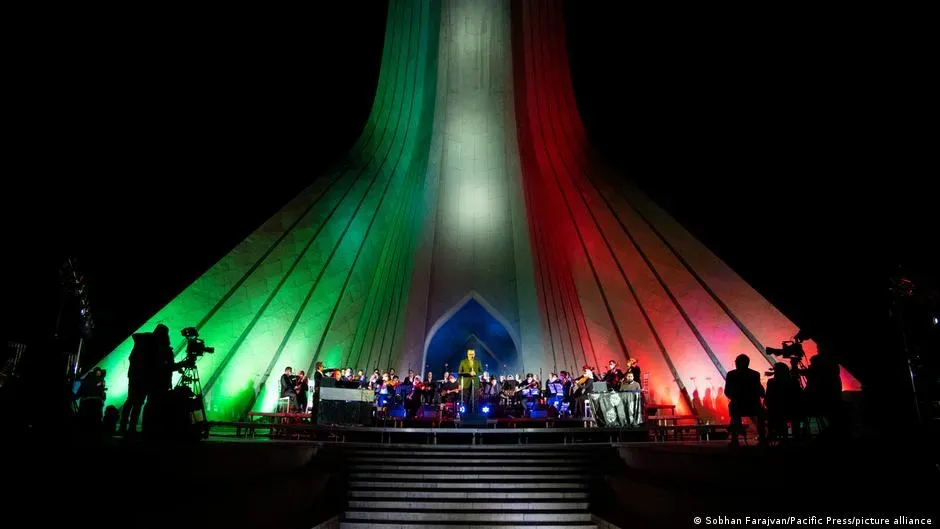
Iranian musician Bijan Mortazavi has returned to his homeland after 47 years abroad, marking a significant moment for the country's music scene. As one of Iran's most renowned violinists, singers, and composers, Mortazavi's return is expected to have a substantial impact on the local music industry.
Mortazavi's recent performance with the New York Philharmonic Orchestra at the FIFA World Cup closing ceremony in July 2026 showcased his exceptional talent to an international audience. The event highlighted his ability to bridge cultural divides through music, demonstrating its universal language and power.
In Tehran, Mortazavi and his wife have been spotted taking leisurely walks around the city, greeting passersby warmly as they welcome him back home. Their presence has sparked enthusiasm among locals, who are eager to see what contributions he will make to Iran's vibrant cultural landscape.
The return of musicians like Mortazavi is part of a broader trend, with other artists also coming back to their homeland after years abroad. Singer Mohsen Namjoo, for example, recently returned to Iran after about 20 years in exile, bringing his unique blend of traditional Persian music and experimental styles with him.
Singer Mohsen Namjoo's decision to return to Iran comes amidst efforts by the country's culture ministry to encourage high-profile expatriates to come back home. According to Iranian media outlet Farhikhtegan, the ministry has compiled a list containing the names of over 100 distinguished Iranians living abroad who are being invited to contribute to the country's cultural and artistic development.
The Iranian government has been taking steps to attract renowned artists and intellectuals who have left the country, aiming to remove obstacles that might hinder their return or travel to Iran.
Salehi emphasized that even those critical of the Islamic Republic are free to return at any time, but clarified that simply coming back does not necessarily mean they will be expected to perform in Iran. Instead, he suggested that these individuals could visit the country without any obligation to engage in artistic activities.
Human rights lawyer Sina Yousefi pointed out that international law, specifically Article 12 of the International Covenant on Civil and Political Rights, prohibits countries from arbitrarily preventing their citizens from entering their own nation. This provision is binding for Iran as a signatory to the treaty, he noted.
According to Yousefi, this right cannot be conditional upon an individual's loyalty to the government; it is a fundamental entitlement that applies equally to all citizens, regardless of their level of adherence to state policies or ideologies.
Ethnomusicologist Sepideh Raissadat has been studying Persian music for years and believes that the strategy of targeting influential figures with reformist leanings is not a new approach. As someone who combines artistic performance with scholarly research, she brings a unique perspective to her analysis of Iran's cultural landscape.
The Iranian revolution in 1979 marked a significant turning point for the country's musical landscape. Ayatollah Ruhollah Khomeini's statements on music were particularly noteworthy, as he considered it to be a threat to society.
Khomeini publicly denounced music as early as July 1979, labeling it as "harmful and calling for its complete abolition. In a speech to Radio Darya employees on July 21, 1979, he went even further, describing music as a betrayal of the country and its youth.
The Iranian regime's stance on music was reflected in the media, with newspapers like Keyhan quoting Khomeini as saying that music was like a drug" that must be eradicated. This rhetoric set the tone for the government's approach to music over the years.
Despite these efforts to suppress music, it continued to find ways to resurface during times of national crisis. The Iran-Iraq War from 1980 to 1988 saw a resurgence in revolutionary and religious songs, often used to stir up feelings of patriotism and unity.
The regime's attempts to silence women's voices were also met with resistance, as female choral singing continued to thrive despite efforts to suppress it.
Musical instruments were once forbidden from being displayed on Iranian television, forcing musicians to keep their talents hidden. The authorities would often confiscate or destroy instruments that were discovered in public, leaving musicians to fear repercussions if they carried their gear with them.
The act of listening to prohibited music at home became a bold statement, one that carried significant political weight. When women began singing, it too took on a new level of importance and risk. Raissadat notes that this development was part of the broader cultural and political tensions playing out in Iran during this time.
Social media has become an increasingly influential force in Iran over the past decade, despite not being entirely under government control. This shift is particularly evident among young people, who are now more open to expressing themselves musically without fear of reprisal. Some young women have even been spotted performing in public with guitars and without headscarves.
Young people who lost loved ones during the nationwide protests that swept Iran in late 2025 and early 2026 seem to be driving this trend, according to Raissadat's observations. The demonstrations began on December 28, 2025, but were brutally suppressed by security forces.
Thousands of protesters were reportedly killed during the demonstrations, but the exact number remains unknown due to a severe information blackout enforced by the regime.
The use of music by families mourning their loved ones who died in the protests has become a notable trend. This deviates from traditional Shiite practices and Iranian history, according to Raissadat. At some funerals, mourners instead sang and danced along to music, turning the memorial service into an act of protest.
This deliberate choice of music stood in stark contrast to conventional religious mourning rituals. By doing so, families were able to express their defiance against the political system and connect with each other on a deeper level, according to Raissadat. The musician also noted that dancing in white clothing became another way for mourners to display their resistance.
The use of music as a form of protest has been a powerful expression of dissent in Iran. By turning mourning into an act of defiance, families have found a creative and poignant way to resist the regime's efforts to suppress their voices.
Facts based on reporting originally published by DW English.
You may republish this story, in full or in part, if you credit News Central Site and link to it (licence CC BY 4.0). Photos are not included.