BepiColombo Successfully Enters Orbit Around Mercury
A joint European-Japanese spacecraft, BepiColombo, has reached its destination after an eight-year interplanetary journey and successfully entered into orbit around Mercury on Saturday.
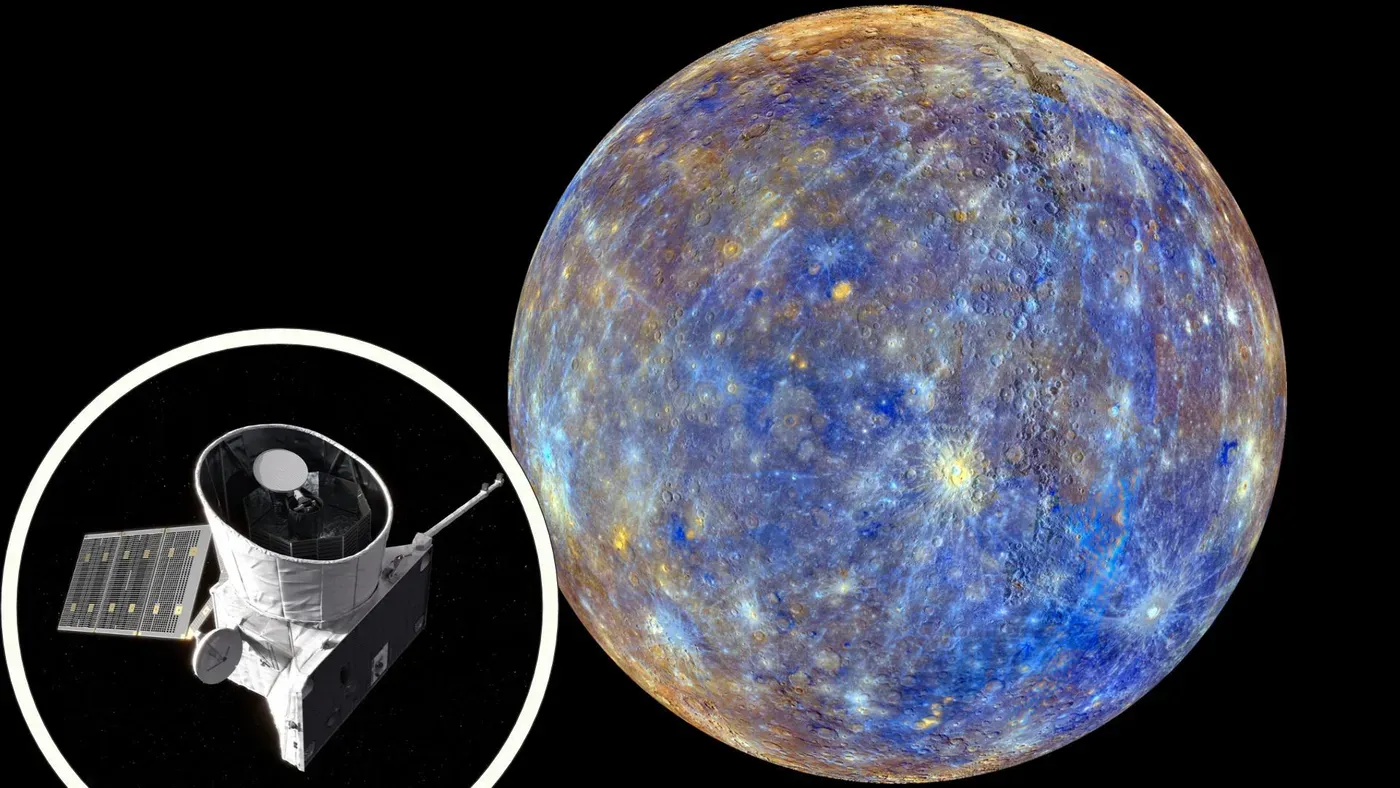
After eight years of traveling through space, a joint European-Japanese spacecraft has finally reached its destination: Mercury, the closest planet to the sun. The BepiColombo mission, which has been making its way around the inner solar system, successfully entered into orbit around Mercury on Saturday.
The confirmation of the orbital insertion came from mission scientists, who reported that the spacecraft is now transmitting data back to Earth. However, there was a slight hitch in the process - a software glitch caused the spacecraft's thrusters not to fire for the full 37 minutes required to slow down its approach to Mercury. Despite this issue, the European Space Agency has confirmed that BepiColombo remains safe.
The orbital insertion didn't quite go according to plan, with the spacecraft experiencing some unexpected delays due to a technical problem. According to officials at the European Space Agency, an investigation is underway to determine the cause of the software glitch and its impact on the mission's trajectory.
The BepiColombo spacecraft has finally arrived at Mercury after an eight-year interplanetary journey. The ambitious mission consists of two separate orbiters: the Mercury Planetary Orbiter (MPO) and the Mercury Magnetospheric Orbiter (Mio), each equipped with its own science instruments.
These instruments will soon start gathering data on the mysterious inner planet, which is about 36 million miles from our star. As Mercury orbits so close to the sun, it's a challenging task for spacecraft to reach it without being pulled off course by the sun's gravitational force. The complicated journey included six flybys of Mercury itself and passes by Earth, the moon, and Venus.
The orbital paths of the two probes will soon diverge, allowing them to collect different streams of data on the planet's magnetosphere, geology, and composition. This mission is a significant milestone in space exploration, especially considering that only one other spacecraft, NASA's MESSENGER probe, has successfully entered Mercury orbit before.
The MESSENGER probe orbited Mercury from 2011 to 2015 after its own seven-year journey through space. The success of this mission will provide valuable insights into the formation and evolution of our solar system, particularly in regards to the innermost planet.
The twin spacecraft, MPO and Mio, are poised to begin their close-up study of Mercury's surface after months of preparation.
In early December, the two probes will separate, with Mio entering a highly elliptical orbit around Mercury's poles, allowing it to survey areas that have never been mapped before.
MPO, meanwhile, will continue on its current trajectory, fine-tuning its path over several more months until it reaches a lower and more circular polar orbit in March 2027.
Once settled into their orbits, the probes will start mapping Mercury with unprecedented detail, making multiple passes around the planet every day.
The scientific instruments on board BepiColombo will be conducting thorough examinations of Mercury across various frequencies, including X-rays and gamma-rays, as well as ultraviolet light. These observations will provide valuable insights into the planet's magnetic field. The data collected will help scientists better understand the intricacies of this enigmatic world.
The mission's findings are expected to shed light on several long-standing mysteries surrounding Mercury, such as its internal composition and the origin of its magnetic field. Scientists will also be able to investigate how the planet formed and whether it is still geologically active today. This wealth of new information will help researchers refine their understanding of this least-explored world in our solar system.
The precise measurements of BepiColombo's orbit and position will enable a radio experiment that puts Einstein's theory of general relativity to the test, providing further insight into the fundamental nature of gravity. The mission marks a significant milestone in humanity's exploration of Mercury, with ESA poised to provide updates on this groundbreaking endeavor. This historic visit to Mercury promises to yield a wealth of new knowledge and discoveries.
Facts based on reporting originally published by Live Science.
You may republish this story, in full or in part, if you credit News Central Site and link to it (licence CC BY 4.0). Photos are not included.