Artificial Intelligence Tool MutexaGPT Developed to Enhance Human Ingenuity in Enzyme Engineering
Chemists at Vanderbilt University have developed an artificial intelligence tool called MutexaGPT, designed to augment the work of scientists rather than replace them.
Chemists at Vanderbilt University have developed an artificial intelligence tool called MutexaGPT, designed to augment the work of scientists rather than replace them.
The team behind MutexaGPT, led by assistant professor Zhongyue (John) Yang, aims to utilize AI to enhance human ingenuity in the field of enzyme engineering. Enzymes are crucial for various chemical reactions that underpin our daily lives, from synthesizing new medications to preserving food and recycling plastics.
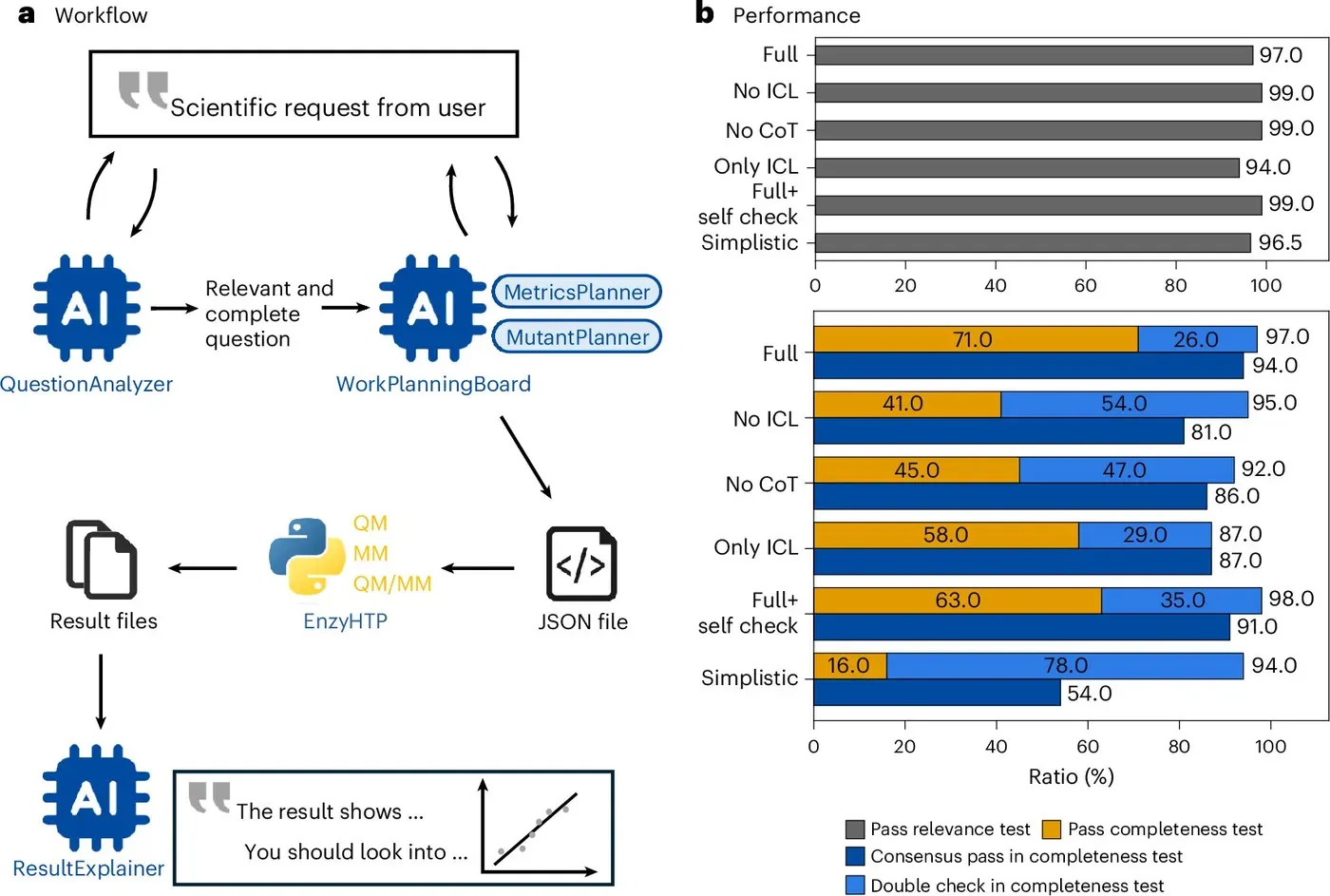
MutexaGPT can process plain-English requests and convert them into actionable design proposals using large language models and physics-based simulations. This tool is intended to facilitate the customization of enzymes, which would otherwise require extensive expertise and computational resources.
Yang acknowledges concerns about AI replacing human workers but emphasizes that MutexaGPT's purpose is to leverage AI as a means to translate human intuition into workable plans rather than automating tasks. The team believes this approach can unlock new possibilities for scientists who may not have the necessary technical expertise or time to execute complex designs on their own.
The development of MutexaGPT has been published in Nature Computational Science, marking an important milestone in the integration of AI and human ingenuity in scientific research.
Enzymes are crucial catalysts in nature, comprised of hundreds of amino acids that can be altered to change their function significantly even with a single mutation.
The challenge lies in predicting these mutations without relying on trial and error, which is costly and resource-intensive for industries like enzyme engineering that generate massive revenue annually.
MutexaGPT aims to revolutionize this process by using artificial intelligence and fundamental principles of chemistry and physics to enable researchers to explore, predict, and design enzyme mutations through natural language.
This AI tool can assist with various tasks, including the development of cold-active enzymes that remain effective at lower temperatures, a crucial aspect for processes like lactose-free milk production and food preservation.
MutexaGPT's capabilities also extend to designing more efficient and selective enzymes, which in turn makes pharmaceutical manufacturing more sustainable by reducing energy consumption, chemical waste, and reliance on harsh conditions.
The AI tool, MutexaGPT, is designed to assist scientists in designing enzyme mutants through a conversational interface. This intuitive system allows researchers to communicate with MutexaGPT using natural language, enabling them to navigate the complex world of enzyme mutations more efficiently.
MutexaGPT's capabilities are made possible by the integration of large language models, which connect users' questions to sophisticated computational tools for enzyme engineering. The goal is to make the process of designing enzymes more accessible and user-friendly, much like how Amazon Alexa helps people accomplish everyday tasks through voice commands.
The developer of MutexaGPT, Yang, has a background in pure computational chemistry, having earned his Bachelor of Science from Nankai University's Chang Po-ling Program of Chemistry. He later completed his doctorate at UCLA and had a postdoctoral fellowship at MIT before joining the faculty at Arts and Science.
Yang's experience and expertise have been crucial in developing MutexaGPT, which is designed to assist scientists in designing enzyme mutants through a conversational interface. This innovative tool has the potential to streamline the process of enzyme engineering and make it more accessible to researchers.
The development of MutexaGPT marks an important step towards making pharmaceutical manufacturing more sustainable by reducing energy consumption, chemical waste, and reliance on hazardous materials.
The development of MutexaGPT has been hailed as a significant breakthrough for researchers working on enzyme engineering and design. According to Yang, these experts often rely on their intuition to understand how enzymes work, but may struggle to quantify this understanding or translate it into practical designs.
MutexaGPT is an AI tool that can take the principles behind enzyme engineering developed by scientists and turn them into tangible designs. This ability to bridge the gap between theoretical knowledge and practical application has been likened to consulting a digital assistant, allowing researchers to work more efficiently and effectively.
The potential impact of MutexaGPT is vast, with applications in medicine, sustainable manufacturing, and everyday consumer products. By accelerating innovation in these areas, scientists can unlock new possibilities for improving human health and the environment.
Facts based on reporting originally published by Phys.org.
You may republish this story, in full or in part, if you credit News Central Site and link to it (licence CC BY 4.0). Photos are not included.