Abelardo de la Espriella's Social Media Campaign Showcases Security Forces' Operations
Colombia's new president Abelardo de la Espriella has been using social media to showcase his security forces' operations against armed groups since taking office in August.
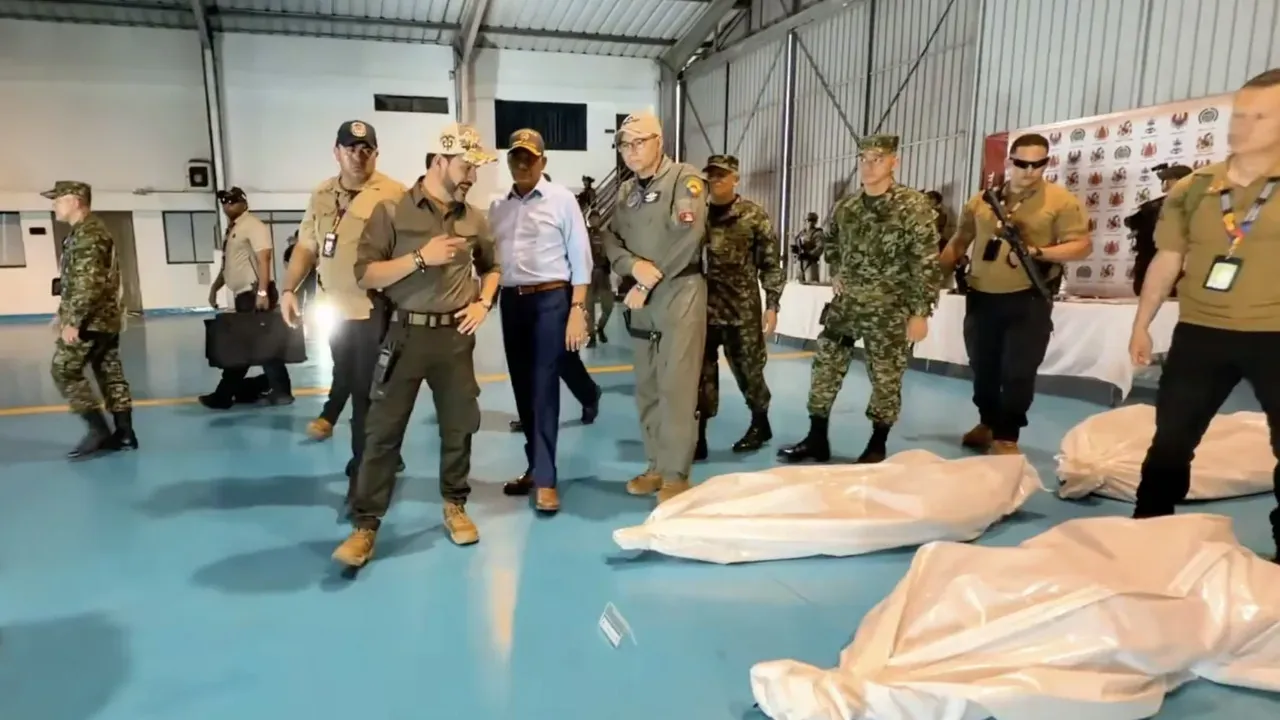
Colombia's new president Abelardo de la Espriella has been using social media to showcase his security forces' operations against armed groups since taking office in August. The videos often feature De la Espriella himself speaking directly to the camera, sometimes standing among body bags.
One such video was published on September 2 and shows De la Espriella in a room filled with 23 body bags. He is discussing an operation carried out against a dissident faction of the Revolutionary Armed Forces of Colombia (FARC), a former guerrilla group. According to De la Espriella, the operation resulted in the deaths of 23 "terrorists, who he likened to cancer.
The video has been viewed nearly half a million times since its posting, and is just one example of De la Espriella's use of social media to promote his security policies. Two days after publishing this first video, De la Espriella shared another similar clip.
This second video shows De la Espriella standing in front of four body bags, applauding the death of a leader from the Conquering Self-Defence Forces of the Sierra Nevada (ACSN), a paramilitary group. In the video, he warns that those who refuse to surrender will meet the same fate as the deceased.
De la Espriella's message in this video is clear: his government believes that peace can only be achieved through armed force. He has pinned this video on his social media profile, where it has already been viewed two million times.
The videos have sparked a growing outcry over De la Espriella's use of repressive policies to promote himself and his security forces. Critics argue that such tactics are counterproductive and will only fuel further violence in the country.
The new president's communication strategy has been met with widespread criticism in Colombia, where two videos featuring body bags have sparked outrage.
Critics argue that using deceased individuals as a backdrop for presidential declarations is insensitive and perpetuates a culture of violence.
One such critic is Iris Marin Ortiz, the People's Defender, who expressed her disapproval on September 6. She noted that the country has been plagued by armed conflicts and organized criminality for decades, but never before had a president boasted about walking amongst the dead.
The display of body bags, according to Ortiz, sends a disturbing message: that death is a means to demonstrate authority. This, she emphasized, cannot become the language of the state.
NGOs dedicated to human rights have also condemned the videos, arguing that they dehumanize individuals and legitimize violence against them.
The Colombian president's unorthodox communication strategy has sparked widespread criticism, with many questioning the ethics of publishing videos that show him walking among body bags.
In a move that drew attention to his methods, Parliamentary Deputy Santiago Osorio Marin took the matter to the Bogota tribunal, which ordered the videos to be temporarily removed from the official Instagram account of the Colombian president on September 8.
Despite this setback, the president continued to share similar content, including a video published on September 21 after an operation against the paramilitary group ACSN. The images have been widely criticized for their graphic nature and potential impact on public perception.
The president has also shared videos showing prisoners with their faces uncovered, wrists and ankles bound, as well as footage of airstrikes from the sky. One such video was published on September 2 after an operation carried out against a dissident faction of former guerrilla group FARC.
These tactics have drawn comparisons to those employed by El Salvador's president Nayib Bukele, who has faced criticism for his war on gangs and subsequent sharing of graphic images. The Colombian president's methods have also been likened to the Trump administration's use of aerial strikes in the Caribbean and eastern Pacific, which resulted in over 240 deaths.
The videos posted by the Colombian president have sparked concerns about dehumanization and the potential for violence against individuals featured in them. Critics argue that such content can be used to legitimize harm towards those shown.
The sharing of these images has also raised questions about the role of social media in presidential communication, with many wondering if this approach is effective or simply attention-seeking.
The Colombian president's communication style has been criticized for creating a narrative that portrays him as an effective leader who produces results.
De la Espriella often incorporates music from action movies into his videos about law enforcement operations or arrests made. This approach was evident in a video shared on October 2, where he discussed Operation Perla aimed at combating extortion and kidnapping.
Critics argue that the president's communication strategy relies heavily on visual aids such as images of body bags, which can be perceived as sensationalistic rather than informative. The use of dramatic music and rhetoric also contributes to this perception.
The results of De la Espriella's hardline policies have been met with widespread condemnation from various sectors in Colombian society. The phenomenon known as false positives has resurfaced, where security forces extrajudicially kill civilians who are then presented as guerrillas killed in combat.
Between 1990 and 2016, a total of 7,837 false positives were documented by Colombia's Special Jurisdiction for Peace. Most of these incidents occurred during the 2000s when security forces aimed to increase their body count to gain various advantages.
The recent death of an eighteen-year-old man named Ricardo Andrés Rodriguez Martinez has drawn parallels with this dark period in Colombian history. He was killed during operations against a paramilitary group, ACSN, which President De la Espriella had praised earlier.
His family's claims that the young man was not a guerrilla fighter but rather a day labourer have sparked outrage and calls for truth and justice to be served. The mother of the deceased appeared in a video filmed in front of the Institute of Forensic Medicine in Barranquilla, holding a poster that demanded accountability from the president.
The People's Defender has called for a thorough investigation into the circumstances surrounding the death of an 18-year-old man who was found among body bags in a military deployment zone. The official expressed concern that such incidents would not be tolerated and emphasized the need to uncover the facts.
In response, the Ministry of Defence stated that it would leave the investigation to the Office of the General Prosecutor and forensic experts. However, this stance has been met with skepticism by critics who argue that a more proactive approach is needed in light of Colombia's history of false positives.
One such case involved Luis Carlos Mojica Guzman, who was killed in September, while another recent incident involved Yasmin Rodriguez, who lost her life in October. These cases have reignited concerns about the military's tactics and their impact on local communities.
The United Nations has also weighed in on the situation, criticizing De La Espriella's repressive methods and warning that they may not address the root causes of violence in the region. The UN emphasized the need for an institutional response to security issues, including education, health, and respect for human rights.
Critics argue that the government's focus on security is at the expense of other important issues, such as rural development, land distribution, and reintegration programs for former combatants. This approach may only treat the symptoms of violence rather than addressing its underlying causes.
The UN also highlighted the importance of working with local communities to address their concerns and needs. If not accompanied by an institutional response, military actions may be seen as ineffective and potentially counterproductive in the long run.
Armed groups in conflict zones often react to increased military presence by tightening their grip on territory and limiting civilians' access to essential resources. This can lead to further human rights abuses as communities become trapped between warring factions.
The president's emphasis on results" seems more like empty rhetoric, disconnected from the actual situation on the ground. The Office of the President declined to comment on these concerns, leaving questions unanswered.
Facts based on reporting originally published by France 24 English.
You may republish this story, in full or in part, if you credit News Central Site and link to it (licence CC BY 4.0). Photos are not included.