US Government Takes 10% Stake in Intel Corporation
The US government has taken a significant stake in Intel Corporation after Commerce Department lawyer David Shapiro made it clear that giving the US government a stake was not up for debate.

A US government takeover of a major semiconductor company has left industry experts stunned and wondering what this means for the global tech landscape.
According to internal company documents obtained in a federal lawsuit, Commerce Department lawyer David Shapiro made it clear that giving the US government a stake in Intel Corporation was not up for debate. In an August 2025 call with Intel's chief financial officer, Shapiro stated that any hesitation would be seen as a "mistake of thinking that this is a negotiation".
Intel's board ultimately acquiesced to the administration's demands, leading to President Trump announcing on his social platform that the US government now owns and controls 10% of the company. This development came with a price tag: Intel shares are valued at approximately $11 billion.
President Trump celebrated what he saw as a major victory for American interests, claiming that the US paid nothing for its stake in Intel. However, this assertion has raised eyebrows among experts who point out that such transactions often have far-reaching consequences.
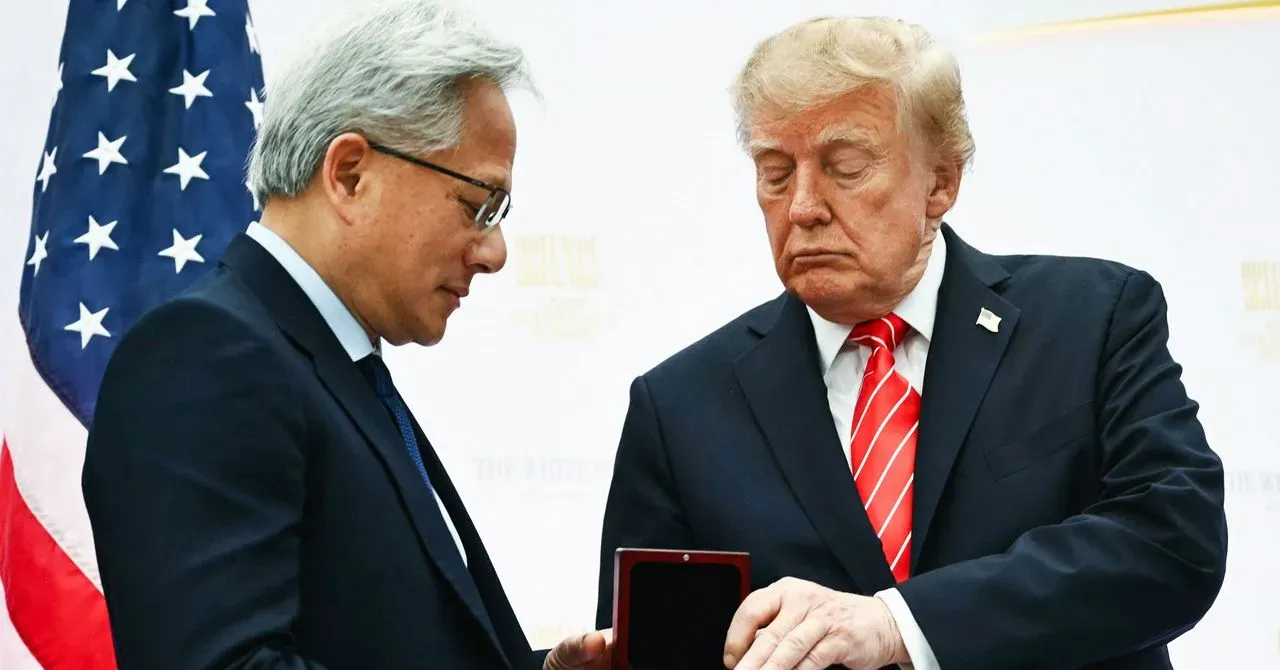
In a separate development, President Trump also revealed on Monday that he had successfully pressured Nvidia's board of directors to rehire chief executive Jensen Huang, sparking controversy and raising questions about the limits of presidential influence over corporate decision-making.
A shift is underway within the Commerce Department, driven by a new set of priorities that depart from traditional metrics such as job creation and market share dominance.
These changes are not limited to the department's inner workings; they reflect a broader trend in government circles. Former officials confirm this assessment, citing a renewed focus on securing specific business outcomes.
Internal documents obtained through a shareholder lawsuit against Intel's board provide insight into the extent of these efforts. The unredacted records reveal the administration's willingness to exert pressure to achieve its objectives.
A similar case has been filed by the same shareholder, Richard Paisner, seeking internal Nvidia records. This development suggests that the administration is using multiple avenues to influence corporate decision-making.
Critics argue that this approach amounts to coercion, undermining the principles of a free market economy. Scott Lincicome, vice president at the Cato Institute, describes it as "straight-up coercion.
The parallels between Intel and Nvidia cases are notable, with the White House intervening in both instances to secure desired outcomes. However, there are differences in the manner and tone of these interventions.
Intel's new CEO Lip-Bu Tan had barely taken the reins when he faced intense scrutiny from the Trump administration.
The Commerce Department had been grumbling about funding Intel under the CHIPS and Science Act grants, labeling it a failing incumbent" in the semiconductor space.
Tan's background as an investor in hundreds of Chinese tech firms, some with ties to Beijing's military, raised red flags for the president.
A Reuters report exposing Tan's investments caught Trump's attention, who was already wary of China's influence on US companies.
The news sparked a flurry of activity, with Intel's funding held up and officials scrambling to renegotiate deals.
As Intel's deal with Cadence Design Systems was being finalized, concerns about Lip-Bu Tan's business ties to China continued to plague the negotiations.
Tan had assured Intel's board in a letter that he would divest himself of his Chinese holdings and place any proceeds into a blind trust, but this move failed to alleviate all worries about potential conflicts of interest.
A source familiar with the matter revealed that Tan's primary goal was to eliminate any doubts about his own background and investments, which had raised eyebrows among Intel officials.
Intel itself faced significant financial concerns, as it struggled to reconcile its relationship with Cadence with the need to satisfy government requirements for US companies involved in sensitive technology deals.
Intel's board of directors met in a closed-door session and made it clear they were unhappy with the economic terms proposed by the Administration.
According to meeting minutes reprinted in a lawsuit, Intel's executives felt that the deal was not attractive in its current form.
Despite their reservations, Intel decided to proceed with the agreement, which would have seen the company hand over about 10% of its stock for free in exchange for government backing.
Intel's lawyers dispute this account, arguing that negotiations were ongoing and that the final deal was more favorable to the company than initially proposed.
The controversy surrounding Intel's dealings with the Administration is just one part of a larger story involving the White House's efforts to secure investments from major tech companies.
The Nvidia leader's eagerness to sell semiconductors to China was matched only by his willingness to negotiate favorable terms. Trump reportedly made a significant demand: that China pay for these sales as if they were a domestic transaction. This unusual request led to the establishment of a 15 percent rebate on all H20 model chip sales. The arrangement marked a departure from typical business practices, where countries typically do not subsidize foreign purchases.
Following this agreement, Nvidia and Chinese officials renegotiated another deal, this time concerning the more advanced H200 chips. In exchange for these sales, China agreed to provide a 25 percent bounty on each transaction. These concessions were made under intense pressure from top US administration officials, who reportedly worked tirelessly to secure favorable terms for American companies.
Nvidia's attorneys have defended their company against allegations of politicization, arguing that Huang's reinstatement was motivated by a desire to protect the business rather than make a statement. This stance is echoed in a May letter from Nvidia's lawyers, which emphasized the company's commitment to remaining apolitical. The controversy surrounding Nvidia's dealings with the White House has sparked concerns about the role of politics in corporate decision-making.
The reinstatement of Huang marked a rare instance where top administration officials successfully intervened on behalf of an American business leader. With pressure from Trump and his team ultimately yielding results, it remains to be seen whether this development will have far-reaching implications for Nvidia's future dealings with China.
Facts based on reporting originally published by Wired.
You may republish this story, in full or in part, if you credit News Central Site and link to it (licence CC BY 4.0). Photos are not included.