Temporary Ceasefire Brings Respite to Residents Trapped in Ukraine's Kherson Region
A brief ceasefire has brought temporary respite to residents trapped in Ukraine's Kherson region, where the village of Kozatske is situated on the frontline between Ukrainian and Russian forces.
A brief ceasefire has brought temporary respite to residents trapped in Ukraine's Kherson region, where the village of Kozatske is situated on the frontline between Ukrainian and Russian forces.
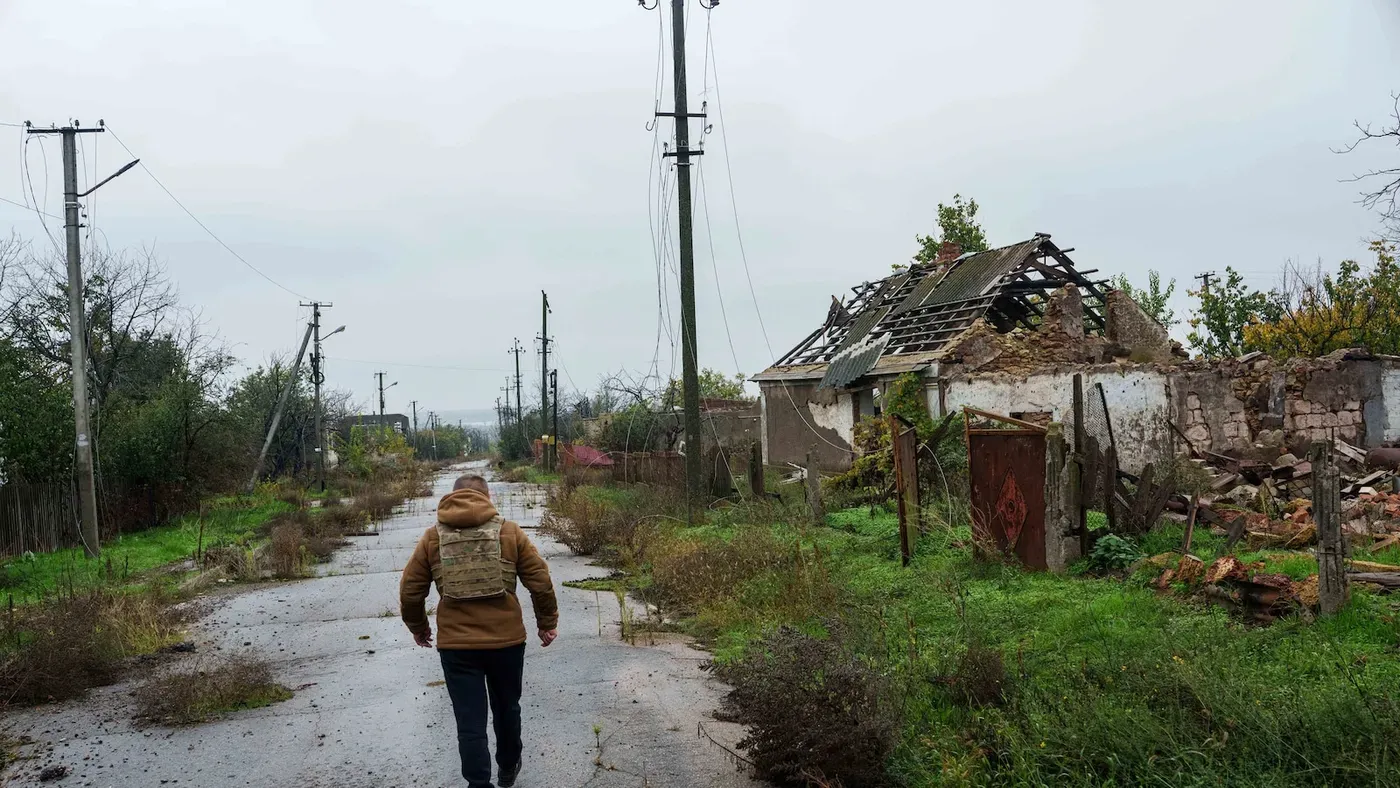
The 53-year-old Nataliia Diadiuk lives in one of the few remaining homes in Kozatske, a riverside village less than two kilometers from Russian-controlled areas. With basic supplies scarce, she has resorted to gathering rainwater for drinking and firewood for heating her home.
Diadiuk's daily life is marked by fear and uncertainty, as she navigates the dangers of living on the edge of a war zone. A white towel hung on her gate and a white rag held in her hand are her only means of signaling to Russian drone operators that she is a civilian, attempting to avoid being targeted.
As the residents of Kozatske struggle to survive, Diadiuk longs for silence and the return of those who have fled. She wants to see her neighbors again, many of whom have been forced to leave due to the intense fighting in the area.
The local residents' plight is further complicated by the presence of mines scattered throughout the village, making every step outside a perilous one. Despite these challenges, Diadiuk remains determined to stay in her home, even as she acknowledges the risks involved.
A team from an international news organization has gained rare access to this so-called red zone, where they witnessed firsthand the dire conditions faced by those living in the kill zone of Ukraine's Kherson region.
Civilians are trapped in various locations on both sides of the front line, mirroring the dire situation in Oleshky. Regional officials, police, and volunteers, facilitated by civil-military cooperation specialists, used the brief ceasefire to reach people cut off for nearly two years.
A total of 180 people were evacuated from riverside communities and Kherson city, including 23 children, according to the regional administration. This leaves approximately 140,000 individuals still living in the Ukrainian-held part of the region. The pre-war population of this area was around 1 million residents.
The region is now largely under Russian control, with nearly 70% of its territory seized by Russian forces. The riverside areas are designated as a red zone, signifying the highest level of military danger due to ongoing drone strikes and artillery bombardments. Residents will once again face these risks following the ceasefire's end.
Abandoned cars sit on roadsides where they were hit, alongside destroyed ground robots that Ukrainians have attempted to deploy down treacherous routes. A lone reminder of peacetime still stands: a "Thank you for keeping the roadside clean" sign, now surrounded by devastation.
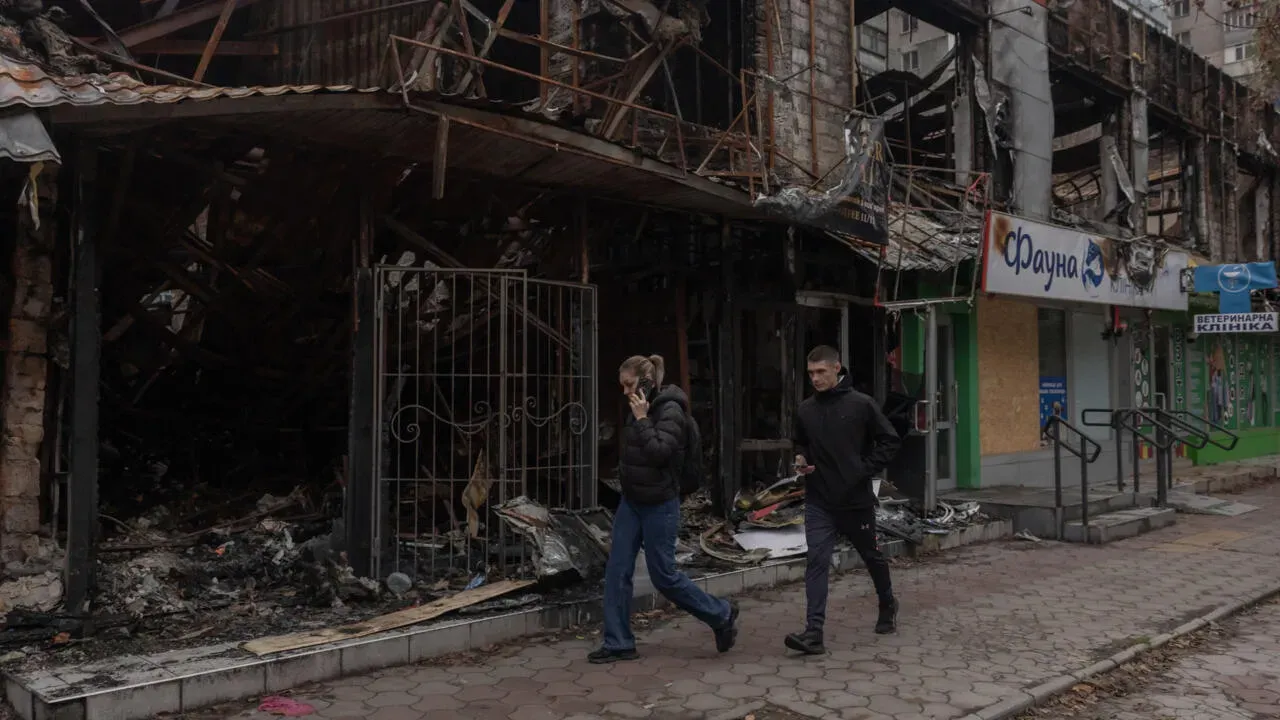
Many houses in Diadiuk's village are reduced to charred walls, while glide bombs have created craters and shell fragments protrude from the asphalt like twisted metal flowers. Mines dropped from drones lie scattered throughout the area, some resembling intricate petals or wrapped in makeshift materials that require careful avoidance.
The aftermath of war is evident in the overgrown ruins of empty houses, where vegetation has reclaimed what's left behind. This stark contrast highlights the harsh reality faced by those living in this conflict zone.
As Diadiuk navigates the treacherous landscape of Kozatske, she's confronted by the haunting sounds of abandoned dogs howling in the distance. These canine companions have become an integral part of her daily life, and she struggles to leave them behind despite the danger.
The prolonged siege has taken a toll on Diadiuk's sense of time, making it difficult for her to keep track of days. She only checks her phone occasionally to determine the current date, as charging the device is a laborious process that requires solar panels.
To ensure access to safe drinking water, Diadiuk employs a makeshift filtration system. Rainwater is collected and strained through gauze before being treated with chlorine and boiled. Although the water quality has improved somewhat, the presence of dead bodies in nearby houses makes it difficult to fully trust its safety.
The village's ordeal began shortly after Russia's full-scale invasion when Kozatske was occupied by Russian forces. Following Ukrainian liberation, the area gradually came under siege from drones as the conflict escalated into a more technological war.
Resident Oleksii Shavokin has adapted to life in the besieged village by rationing his food and relying on old humanitarian aid for sustenance. He's managed to maintain a meager diet that consists of eggs from his remaining hens, which he carefully conserves to last as long as possible.
Shavokin's home was damaged in an early 2023 mortar attack, but he's since repaired the structure and continues to reside there. His weight has significantly decreased due to the scarcity of food, dropping by approximately 30 kilograms from a pre-war total of nearly 100 kilograms.
The dire situation in Kherson's riverside kill zone has left many residents torn between staying and fleeing for their lives. For those who choose to stay, the risk of being caught in crossfire or hit by a stray bullet is ever-present.
Many of these residents are hesitant to leave because they fear that once they depart, they will be left without means to survive. Oleh Tarabaka, head of the Nova Kakhovka city military administration, explained that this is a common concern among those who have lived in Kherson their entire lives. They worry about losing their livelihoods and having no one to rely on.
The fear of uncertainty and the unknown has taken hold of many residents' minds, making it difficult for them to make a decision about leaving or staying. Tarabaka noted that this is not just a matter of survival but also about the psychological toll of living in such conditions.
Some residents are more willing to leave than others, often due to persuasion from military officials and evacuation groups. In some cases, family members have been able to convince their loved ones to make the decision to leave, as was the case with Yevhen and his mother Antonina.
The temporary lull in fighting has provided a brief window of opportunity for evacuations to take place, but it remains unclear how long this reprieve will last. The situation on the ground remains precarious, and residents are holding their breaths as they wait to see what the future holds.
The temporary ceasefire in Kherson city has provided a rare opportunity for residents to escape the dangers that have made their town a kill zone. The streets are eerily empty, save for the sounds of weeping and wailing from those who refuse to leave.
Under normal circumstances, evacuation efforts are fraught with peril due to the constant threat of drones and other weapons. However, during the ceasefire week, the Red Cross was able to evacuate significantly more people than usual, taking advantage of the brief window of calm.
Commander Mykola Taranenko of the Ukrainian Red Cross Society's rapid response team in the Kherson region emphasized the risks involved in evacuation efforts. "Right now, some streets and places in Kherson are a kill zone too," he said. It's simply impossible to slip through there without facing very high risk.
The numbers tell a story of just how precarious the situation remains. Normally, the Red Cross evacuates around 10 people per week. But during the ceasefire week, they took out an astonishing 32 individuals, including elderly couples like Volodymyr and Kateryna Yakuba.
As the couple prepares to leave their home behind, Kateryna expressed her gratitude for the temporary reprieve. "We need to get out before the cold sets in," she said, referring to the impending winter months.
The Ukrainian forces' advance has forced Russian troops to retreat from some areas in Kherson, creating a brief window for civilians to escape.
As temperatures drop, the urgency is growing for those trapped in the city's riverside kill zone, where fighting continues despite the ceasefire. The situation remains precarious, with both sides exchanging fire and civilians caught in the crossfire.
Facts based on reporting originally published by ABC News International.
You may republish this story, in full or in part, if you credit News Central Site and link to it (licence CC BY 4.0). Photos are not included.