State Farm Reports Animal Collisions Caused $1.9 Billion in Claims
State Farm's analysis reveals that over 1.6 million automotive claims involving a vehicle were filed for the year ending June 30, 2026.
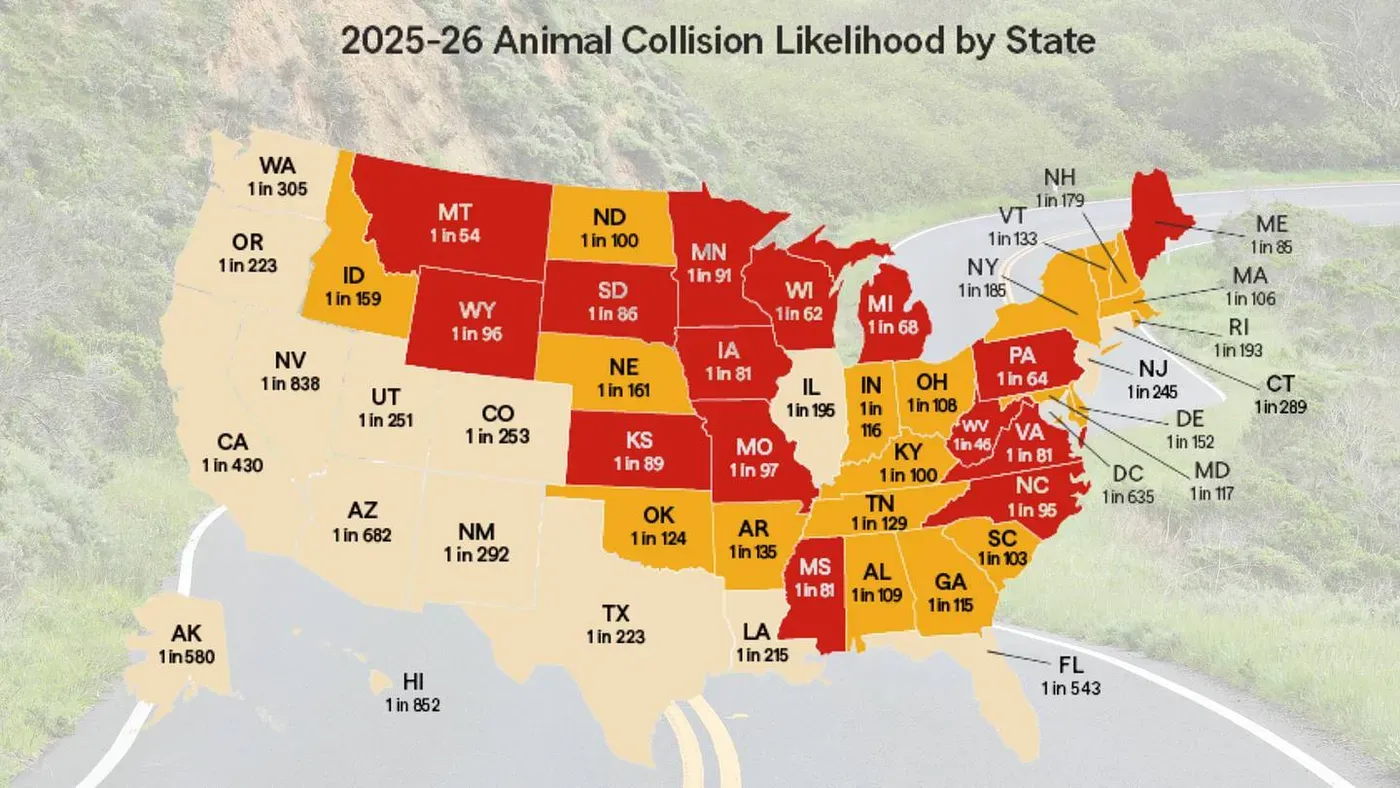
Animal collisions have become a significant concern on roads across the country, causing damage to vehicles and even fatalities. According to data analysis by State Farm, over 1.6 million automotive claims involving a vehicle were filed for the year ending June 30, 2026.
The insurance company found that these incidents resulted in $1.9 billion in claims paid out. This staggering figure highlights the need for drivers to exercise caution when sharing roads with wildlife. Animal collisions can be unpredictable and devastating, making it essential to know which states are most affected by this issue.
Some regions of the country experience a higher frequency of animal collisions than others. State Farm's analysis reveals that certain states have more incidents than others, putting both animals and drivers at risk. Drivers in these areas may need to file claims more frequently due to the increased likelihood of damage.
To identify which states are most prone to animal collisions, it is essential to examine the data and pinpoint the regions with the highest number of incidents. By doing so, we can better understand the scope of this problem and take steps to mitigate its effects.
While some areas may be more susceptible to animal collisions, drivers everywhere must remain vigilant when sharing roads with wildlife. Whether you live in a high-risk state or not, it is crucial to know what to do in case of an animal encounter.
The data suggests that certain states are indeed riskier than others for both animals and drivers. To find out which ones made the list, let's take a closer look at the regions with the most animal collisions.
The likelihood of animal collisions varies significantly across different regions in the United States. While states in the East and Midwest tend to see more frequent animal collisions overall, State Farm's data reveals that many other states also face this issue.
Among these states, West Virginia stands out as a hotspot for animal collisions. Drivers in the state have a notably high chance of hitting an animal while driving, with statistics suggesting a 1 in 46 likelihood of such an encounter.
The top spot is closely followed by Montana, where drivers have a 1 in 54 chance of colliding with animals like deer, raccoons, coyotes, turkeys, and hogs. This diverse range of wildlife poses a considerable risk to motorists navigating the state's roads.
Wisconsin ranks third on this list, with residents facing a 1 in 62 likelihood of hitting an animal while driving. Pennsylvania and Michigan also feature prominently, with respective chances of 1 in 64 and 1 in 68 for drivers encountering wildlife on their roads.
These four states are all connected to the Great Lakes region, which may contribute to the high incidence of animal collisions in these areas.
Wisconsin residents have a 1 in 62 chance of hitting an animal while driving, making it one of the top three states with the most animal collisions. This is likely due to its large deer population, which contributes to a significant number of animal collisions. The state's proximity to the Great Lakes region may also play a role in this high incidence.
In third place, Pennsylvania has a 1 in 64 chance of hitting an animal while driving. Like Wisconsin, it has a substantial deer population, with around 1.5 million deer calling the state home. This abundance of wildlife can make roads hazardous for drivers, particularly during peak migration seasons.
Michigan rounds out the top three states with the most animal collisions, with a 1 in 68 chance of hitting an animal while driving. The state's massive deer population of approximately 2 million contributes to its high incidence of animal collisions. This is consistent with State Farm's findings that deer are the most likely animals to be hit by cars.
The prevalence of large deer populations may explain why these three states, all connected to the Great Lakes region, have such a high likelihood of animal collisions. The combination of abundant wildlife and favorable habitat conditions creates an environment conducive to accidents on the road.
States in other regions fare better when it comes to animal collisions, with those on the West Coast and in the Lower Midwest experiencing significantly fewer incidents. This suggests that factors specific to these areas may be contributing to their lower rates of animal collisions, possibly due to differences in population density or wildlife migration patterns.
Animal collision rates have been steadily declining over the past year, presenting a welcome trend for drivers across the United States.
State Farm's analysis of driving habits indicates that the likelihood of hitting an animal while behind the wheel has decreased in recent times. This downward trend is reflected in the numbers, with the average driver now having a 1 in 145 chance of colliding with wildlife compared to a 1 in 139 chance the previous year.
The decline in animal collisions may be attributed to various factors, including changes in population density and wildlife migration patterns. These variables can significantly impact the likelihood of encounters between drivers and animals on roads and highways.
One notable example of efforts to reduce animal collisions is the implementation of Wildlife Crossing Programs by federal authorities. These initiatives aim to create safer areas for animals to cross, thereby minimizing their chances of entering traffic lanes.
The creation of wildlife crossing programs by federal authorities has shown promise in reducing animal-vehicle collisions. Along Highway 9 in Colorado, for instance, a combination of wildlife crossings and fencing led to a significant decrease in such incidents. When the highway opened, there was a notable drop of 90% in animal collisions.
Driving patterns also play a crucial role in determining the likelihood of hitting an animal on the road. A seasonal analysis reveals that most collisions tend to occur during autumn months. Specifically, October, November, and December account for approximately 41% of all annual collisions, with around 650,000 incidents occurring during this time period.
The data suggests that both infrastructure development and driving habits contribute to the frequency of animal-vehicle collisions. By acknowledging these factors, authorities can work towards implementing more effective measures to minimize such incidents and ensure safer roads for both humans and wildlife.
Facts based on reporting originally published by Mental Floss.
You may republish this story, in full or in part, if you credit News Central Site and link to it (licence CC BY 4.0). Photos are not included.