NATO Drone Manufacturer Partners with Ukrainian Firm for Counter-Drone Systems
A Croatian company and a Ukrainian firm are developing counter-drone systems and interceptor drones through their joint venture.
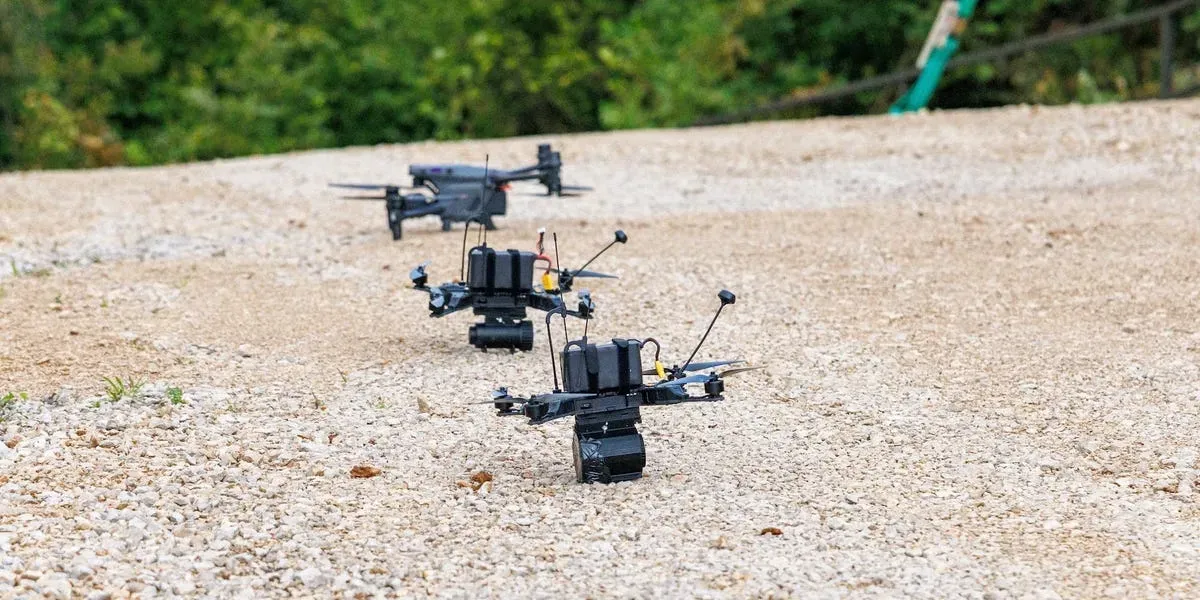
A NATO drone manufacturer has joined forces with Ukraine's defense industry to develop a range of counter-drone systems and interceptor drones.
The partnership between Croatian company ORQA and Ukrainian firm General Cherry is aimed at creating innovative solutions for military defense in crisis situations. As part of their joint venture, they are building an underground factory in Ukraine to manufacture key components.
According to Srđan Kovačević, CEO of ORQA, the experience gained from producing components in Ukraine under wartime conditions will be invaluable for Western defense companies facing similar challenges. He noted that manufacturing in Ukraine and shipping products directly to the military is also a more efficient process than transporting goods from NATO countries.
Ukrainian defense firms have been forced to adopt unconventional manufacturing strategies due to ongoing Russian attacks. To avoid being targeted, these companies are splitting their production across multiple sites and frequently relocating operations. Some work is also being moved underground, a move that may seem counterintuitive but has proven effective in minimizing disruption.
While this approach is less efficient than traditional methods, it provides an added layer of resilience against attacks. Western officials and industry leaders are taking note of these strategies, with some warning that European companies should consider adopting similar practices to mitigate the risks posed by Russian aggression. This shift towards more decentralized production is already underway, driven in part by a desire to learn from Ukrainian companies' experiences.
Kovačević has highlighted the benefits of distributed systems, which are better equipped to withstand disruptions than centralized ones. He believes that closer collaboration between Latvian and Ukrainian defense industries could facilitate knowledge-sharing and help Western companies adapt their production strategies accordingly. Davyd Aloian, a senior official within Ukraine's National Security and Defense Council, has also emphasized the importance of breaking up production to minimize vulnerability to attack.
Ukraine's defense industry is learning to adapt to changing circumstances by dispersing production facilities across multiple locations. This strategy aims to minimize vulnerability to attack, as seen in recent conflicts. While some may argue that consolidating operations would simplify logistics and management.
However, Ukrainian companies are also recognizing the benefits of spreading their production lines across different countries. By doing so, they can share expertise with partner nations and avoid the risks associated with a single location being targeted by Russian forces. This approach is already being implemented in NATO countries.
The company Kovačević's firm supplies drone technology to 24 NATO allies, and instead of concentrating all production in one place, they are choosing to split their work between Ukraine and Croatia.
The benefits of localizing a supply chain extend beyond manufacturing efficiency, as all parties involved can exchange information more quickly and effectively about battlefield needs and operations.
This approach also allows for the sharing of expertise and knowledge gained from Ukraine's own experiences on the battlefield, which can then be applied to NATO's equipment and strategy. By partnering with General Cherry in Ukraine, companies can tap into this valuable insight and integrate it into their products.
In addition to manufacturing drone components in Ukraine, such as electronics and communications systems, the partners are setting up a joint serial-production facility for co-developed interceptor drones and counter-drone systems in Croatia. These systems will be destined for NATO, while the Ukrainian-made components will be supplied to "all our partners" there.
The partnership aims to replicate Ukraine's underground manufacturing capabilities in Croatia, where NATO drones will be produced. This initiative seeks to address a key challenge: while Ukraine can assemble the drones, it lacks the capacity to manufacture components.
ORQA's priorities include reducing reliance on Chinese products, and this project is designed to achieve that goal for both ORQA and Ukraine's industry. The collaboration is structured to avoid disrupting existing supply chains in Ukraine, ensuring continuity of production.
Facts based on reporting originally published by Business Insider.
You may republish this story, in full or in part, if you credit News Central Site and link to it (licence CC BY 4.0). Photos are not included.