Lingerie-inspired designs dominate Spring/Summer 2027 fashion season
The trend of "naked dressing" on runways has sparked debate about the correlation between weight loss medications and fashion choices.
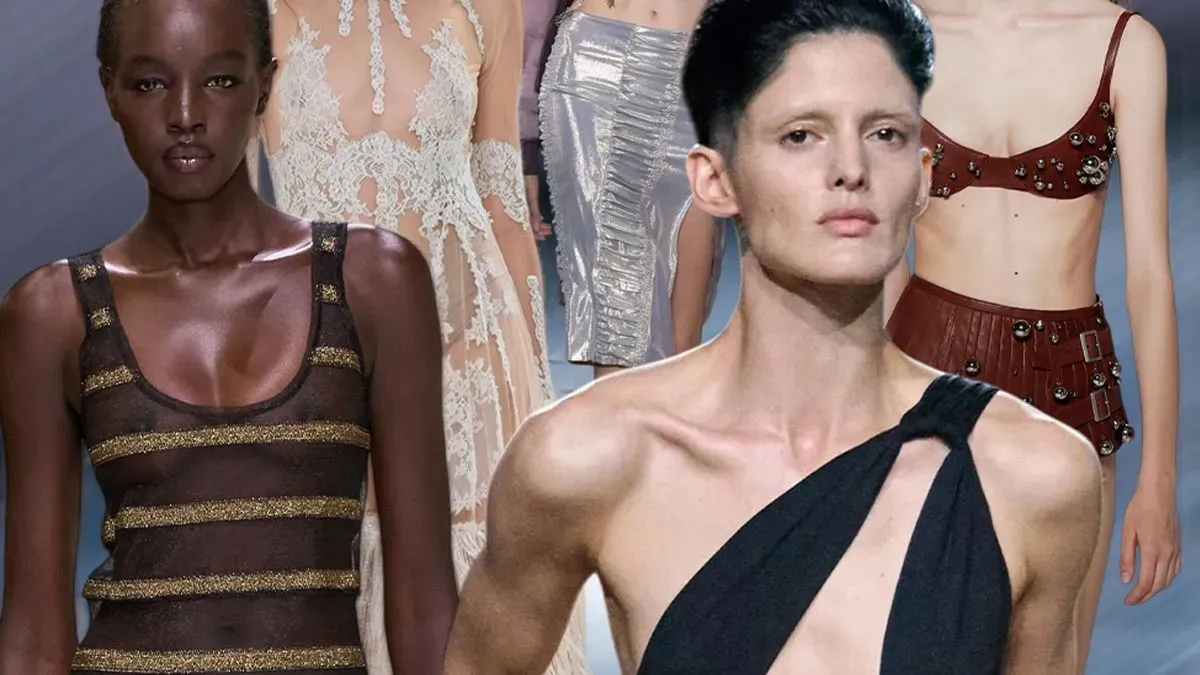
Lingerie-inspired designs dominated the Spring/Summer 2027 fashion season, with designers incorporating sheer fabrics, corsets, and garter skirts into their collections.
Runways were flooded with see-through organza, high-cut briefs, and bullet bras, evoking a sense of nudity that has become increasingly prominent in recent years. This trend raises questions about the relationship between weight loss medications and fashion choices.
The global market for GLP-1s, a class of weight loss medications, is projected to reach $190 billion by 2035, with sales reaching $79 billion in 2025 alone. The use of these medications is expected to become increasingly widespread, with forecasts suggesting that one in three Americans and one in eight Britons will be using them by 2030.
As the use of GLP-1s becomes more prevalent, it's becoming harder to ignore their potential impact on fashion trends. Luxury brands are reportedly seeing a shift in client body measurements, with Paris-based fashion sourcer Isabel Bazzani noting that couture houses have had to update their records due to changes in client sizes.
The trend of "naked dressing and the increasing visibility of skin on runways has sparked debate about correlation and causation. Are designers responding to the growing number of people using weight loss medications by creating clothing that accentuates the body, or is this simply a coincidence?
Bazzani's observations suggest that the shrinking of client bodies is a real trend in high fashion, with luxury brands struggling to keep up with changing size requirements. As the relationship between GLP-1s and fashion continues to evolve, it will be interesting to see how designers respond to these changes.
Fashion analysts are observing a subtle yet significant shift in clothing design that may be linked to the growing popularity of GLP-1s. According to Frida Tordhag, fashion analyst at Heuritech, this change is not straightforward and cannot be directly correlated with runway trends.
While some experts agree with Tordhag's assessment, others see a more complex relationship between GLP-1s and fashion. Krista Corrigan, senior retail analyst at EDITED, notes that her team is still studying the trend to understand its nuances and potential correlations.
Confirming these connections can be challenging, as Corrigan points out. However, she believes that some trends may indeed be influenced by GLP-1s. For instance, design elements such as adjustable straps or elastic hems could become increasingly popular.
The shift towards functional design is also evident in the use of belts as a styling tool. Laura Yiannakou, womenswear senior strategist at WGSN, notes that this trend is not just about aesthetics but also about creating a customizable shape. Supersized belts were featured on runways at Celine, while designers like Valentino used them to create cinched peplum waists.
Design details such as crossed lacing and zippers are becoming more prominent in clothing designs. This functional approach to fashion is being driven by the need for garments that can adapt to individual body shapes and sizes. As Yiannakou notes, belts are no longer just accessories but essential tools for creating a tailored look.
The emphasis on functional design may signal a move away from revealing or skin-baring trends associated with GLP-1s. Instead, designers are focusing on creating garments that provide comfort and flexibility, allowing wearers to feel confident and at ease in their clothing choices.
Designers are focusing on creating garments that cater to the changing needs of consumers, particularly those who experience fluctuations in body size.
In response to this trend, belts and cinched-waist outerwear have become staples of spring/summer 2027 fashion, offering a flexible approach to dressing while accentuating smaller proportions.
Retail data reveals a significant surge in demand for functional clothing, with arrivals of bottoms featuring adjustable waistbands more than doubling month-on-month in May 2026. Similarly, belted bottoms saw a 50% increase year-over-year.
On the runway, designers showcased innovative fastening systems and adaptable silhouettes, including self-tie fabric belts on wide-leg pants at Max Mara and adjustable Velcro fastenings securing skirts at Prada.
Fabrics with breathability and ease are also gaining traction in the fashion industry. Designers such as Issey Miyake incorporated tempo pleats into their designs, while Stella McCartney featured wave-inspired silhouettes.
Column dresses have become increasingly popular, with designers like Alberta Ferretti creating fluid silhouettes and Christopher Esber incorporating cutouts. The silhouette has nearly doubled in dress market share according to WGSN retail data, indicating a strong demand for shapes that sit on the body comfortably.
The trend towards greater body exposure is continuing unabated on the runway and in stores. Data from various sources indicates that consumers are seeking clothing that accentuates their form rather than clinging to it.
This shift away from skin-tight garments is evident in the decline of bodycon dresses and slim pants, which have seen significant drops in sales over the past year. In Europe, bodycon dress arrivals have fallen by 8% year-on-year, while in the US, they are down 6%. Similarly, slim pants have lost popularity, with a 25% drop in Europe, 21% in China, and 20% in the US.
The SS27 runway shows showcased a dramatic departure from the skin-tight aesthetic of previous seasons. Designers opted for garments that accentuated the body through cutouts, lingerie-inspired details, and sheer fabrics. At Gucci and Tom Ford, the focus was on overt displays of flesh, while Chloé and Dior presented more subtle expressions of this trend.
One notable aspect of the SS27 collections is the convergence of volume and transparency. Designers such as Alberta Ferretti, Bluemarine, and The Attico explored this interplay between lace, lingerie features, and sheer fabrics across voluminous silhouettes. This blending of opposing styles has resulted in a new kind of dressing that prioritizes comfort over strict fit.
The rise of sheer and soft fabrics is also a key feature of the current fashion landscape. Fine lace is experiencing significant growth, with increases of 41% in China and 19% in Europe. Dresses made from this fabric are particularly popular, with sales up 49% in China, 37% in Europe, and 19% in the US.
In-store visibility of chiffon and satin dresses is also on the rise, as consumers opt for a softer expression of naked dressing. This shift away from fishnet and mesh fabrics, which are declining in popularity, suggests that consumers are seeking more comfortable and subtle ways to showcase their bodies.
The trend of lingerie-inspired fashion continues to gain momentum this season, with personal shoppers reporting high demand for sheer dresses, tops, and skirts from top designers like Saint Laurent and Chanel.
Saint Laurent's silicone-lace designs are particularly popular among clients, while Hermès's undergarment-revealing pieces have also been in high demand. The trend of lingerie-inspired fashion is not limited to these brands alone, as Heuritech data shows that lace-trimmed camisoles have seen a significant increase in sales across Europe and the US.
In China, the market for lace-trimmed camisoles has grown by an even more substantial 59% year-on-year. The trend of incorporating lingerie details into everyday wear is also evident in the rise of tops with lace detail, which have increased in popularity by 56% in Europe, 43% in the US, and 59% in China.
The runway shows were not immune to this trend either, with bra tops making a notable appearance at various designer labels. At Prada, they were styled as cone-shaped designs, while Jean Paul Gaultier opted for a more futuristic approach. Tod's and Hermès took a more understated approach, using leather and silk scarves to create the illusion of lingerie.
The prevalence of bra tops on the runway has led some to draw parallels with the rise of GLP-1s, which have been associated with weight loss. However, it is worth noting that these medications are not a guarantee for thinness, and their impact on fashion trends remains unclear.
The trend of lingerie-inspired fashion is not limited to just one aspect, as sheer fabrics have also seen an increase in demand. This shift away from fishnet and mesh fabrics may be indicative of a desire for softer, more feminine expressions of naked dressing".
At London Fashion Week, Di Petsa's latest collection showcased a mix of skin-baring designs and inclusive sizing, reflecting the brand's commitment to diversity.
The runway featured transparent dresses, plunging necklines, and models wearing jewelry or their own hands as makeshift cover-ups, yet the emphasis was on showcasing garments in diverse sizes rather than emphasizing nudity. Di Petsa's approach is centered around inclusivity, which has been a core aspect of her brand since its inception.
Designers like Rick Owens in Paris, Marco Rambaldi in Milan, and Collina Strada in New York also prioritized inclusivity on their runways, featuring diverse models in skin-baring designs that challenged traditional notions of body type. As Collina Strada's creative director Hillary Taymour put it, fashion should not be represented by a single body type.
Facts based on reporting originally published by Vogue.
You may republish this story, in full or in part, if you credit News Central Site and link to it (licence CC BY 4.0). Photos are not included.