Ceuta Migrant Crisis Escalates Amid Tensions and Resource Shortages
A monthslong migration crisis has unfolded in Ceuta, a Spanish city on the North African coast, where tensions are running high among residents and authorities alike.
A major migration crisis is unfolding in Ceuta, a Spanish city on the North African coast, where tensions are running high among residents and authorities alike.
Ceuta is a unique place, with an almost equal balance of Muslims and Christians living together in what is often described as a beacon of coexistence. The city's strategic location between Europe and Africa has made it a hub for trade and cultural exchange over the centuries.
However, the recent influx of migrants has exposed deep-seated divisions within the community. A monthslong crisis has been sparked by rumors that Spain had opened its border, attracting thousands of people from neighboring Morocco in late July.
The situation escalated as about 80,000 people poured into Ceuta, with many eventually leaving but up to 15,000 migrants choosing to stay. This has put a significant strain on the city's resources and infrastructure, leading to growing tensions between residents who are struggling to cope with the influx.
Many of those who remain have been forced to take shelter in Muslim neighborhoods, where they often sleep on streets or in makeshift tent camps set up by non-governmental organizations (NGOs) and local volunteers.
Residents of Ceuta are growing increasingly frustrated with the ongoing migration crisis, which has put a strain on the city's resources and infrastructure.
Volunteers at the Luna Blanca charity have been working tirelessly to provide meals for migrants still in the city, distributing between 3,000 and 5,000 meals per day. Halima Ahmed, spokesperson for the charity, reported that volunteers and workers have received threats and insults for their efforts.
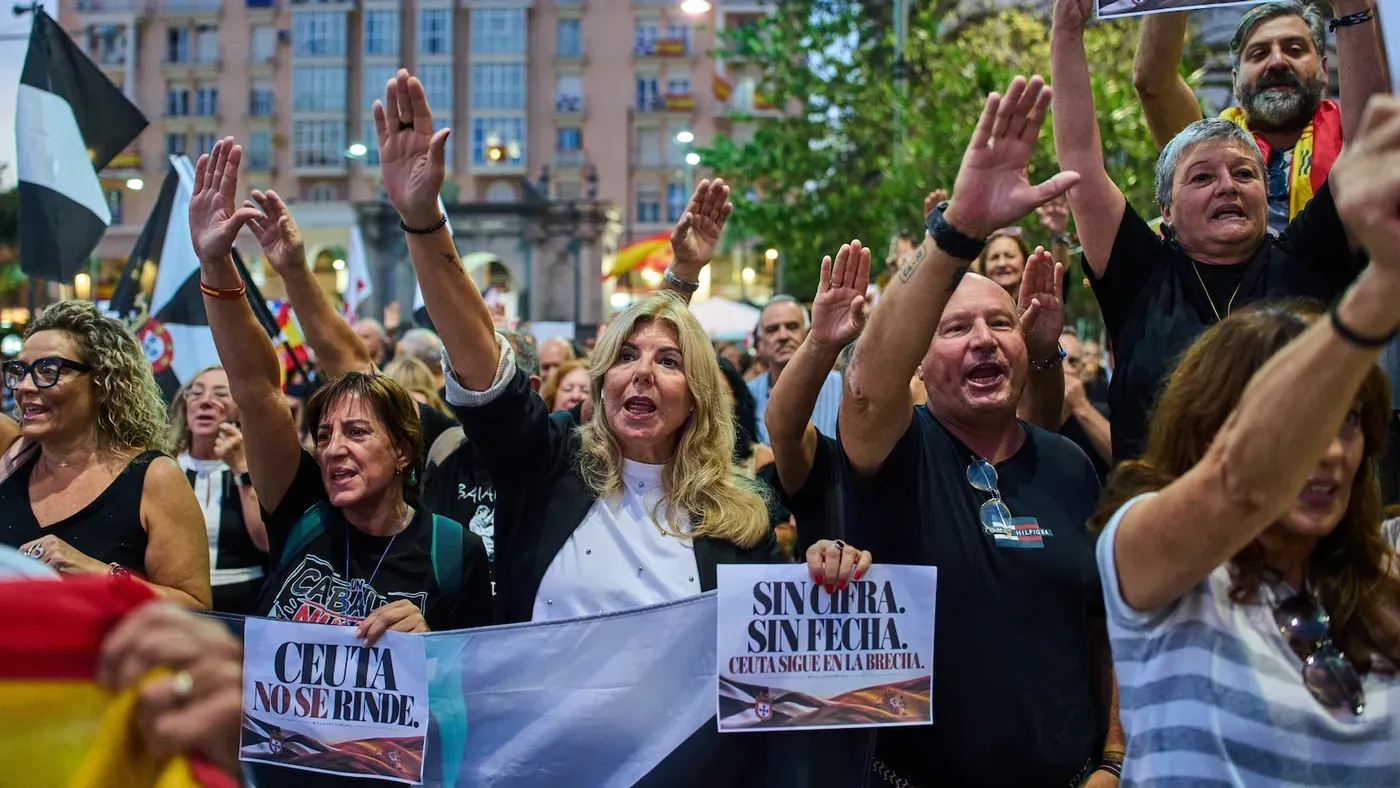
The situation has taken a toll on local businesses, with many storefronts displaying signs of discontent, including "Ceuta stands its ground, Ceuta won't give up!" While some areas of the city are returning to normalcy, such as downtown where people are once again frequenting restaurants and bars, signs of tension abound.
Spanish police and thousands of soldiers have been deployed in the city center and near the border to maintain order. Residents have taken to the streets to protest the crisis, with around 200 people gathering outside the city government in early October to demand solutions from Spain's left-wing national government.
The demonstrations have been largely peaceful, although some participants expressed frustration with the Spanish government's slow response to the crisis. The protests have highlighted the divisions within Ceuta, where very few Muslim residents were seen attending the demonstration.
The economic disparities in Ceuta are a significant concern for many residents, particularly those from the Muslim community. According to a 2025 report by Caritas, a Catholic charitable organization, 44% of Muslim households are marginalized, compared to 28% of the city's overall population.
This stark contrast highlights the difficulties faced by Muslims in the territory. Many have relatives and roots in Morocco, which has led some to question their loyalty to Ceuta. Some residents have expressed concerns that certain individuals from the Muslim community may be prioritizing the interests of migrants from Morocco over those of the local population.
The city's economic struggles are also evident in its infrastructure. Predominantly Muslim neighborhoods on the periphery of the city, with narrow and steep streets, experience high crime rates. In contrast, downtown areas where Muslims and Christians frequently mix have a more vibrant atmosphere, with lively plazas and broad avenues.
Despite these challenges, many residents continue to emphasize the importance of coexistence in Ceuta. With a diverse population that includes Muslims, Christians, Jews, and Hindus, the city has traditionally been known for its tolerance and acceptance. However, recent events have strained this relationship, leaving some to wonder if the fabric of the community is beginning to fray.
The divisions in Ceuta's community have been simmering beneath the surface long before the current migrant crisis unfolded this summer. Local politician Mohamed Mustafa acknowledges that while these tensions were present beforehand, they have undoubtedly worsened due to recent events.
Mustafa's candid assessment is echoed by residents who feel abandoned by their national leaders, a sentiment that will be on full display when Spain's royals visit Ceuta for the first time next week. The monarchs' presence at a Muslim cemetery ceremony to honor over 140 migrants who lost their lives attempting to cross the border in July is a poignant reminder of the human cost of the crisis.
The ceremony, scheduled for Tuesday, will take place at a site where dozens of unidentified migrants have been buried. Ceuta's residents are growing increasingly frustrated with the situation, and while they may differ on how to address it, there is a shared sense of exhaustion and hopelessness that has taken hold in the city.
The demonstration organized by Muñoz aimed to raise awareness about the migration crisis in Ceuta, not to mock those affected by it. In fact, he emphasized that his intention was not to trivialize the situation.
Muñoz acknowledged that despite Ceuta's history of coexistence among different religious and ethnic groups, a rift has developed. He expressed a desire for progress and suggested moving forward as a way to address the issue.
Facts based on reporting originally published by ABC News International.
You may republish this story, in full or in part, if you credit News Central Site and link to it (licence CC BY 4.0). Photos are not included.