Artificial Intelligence Takes Its Place in Hollywood Film Production
A revolutionary change is underway in the film industry with the introduction of artificial intelligence (AI) on sound stages.
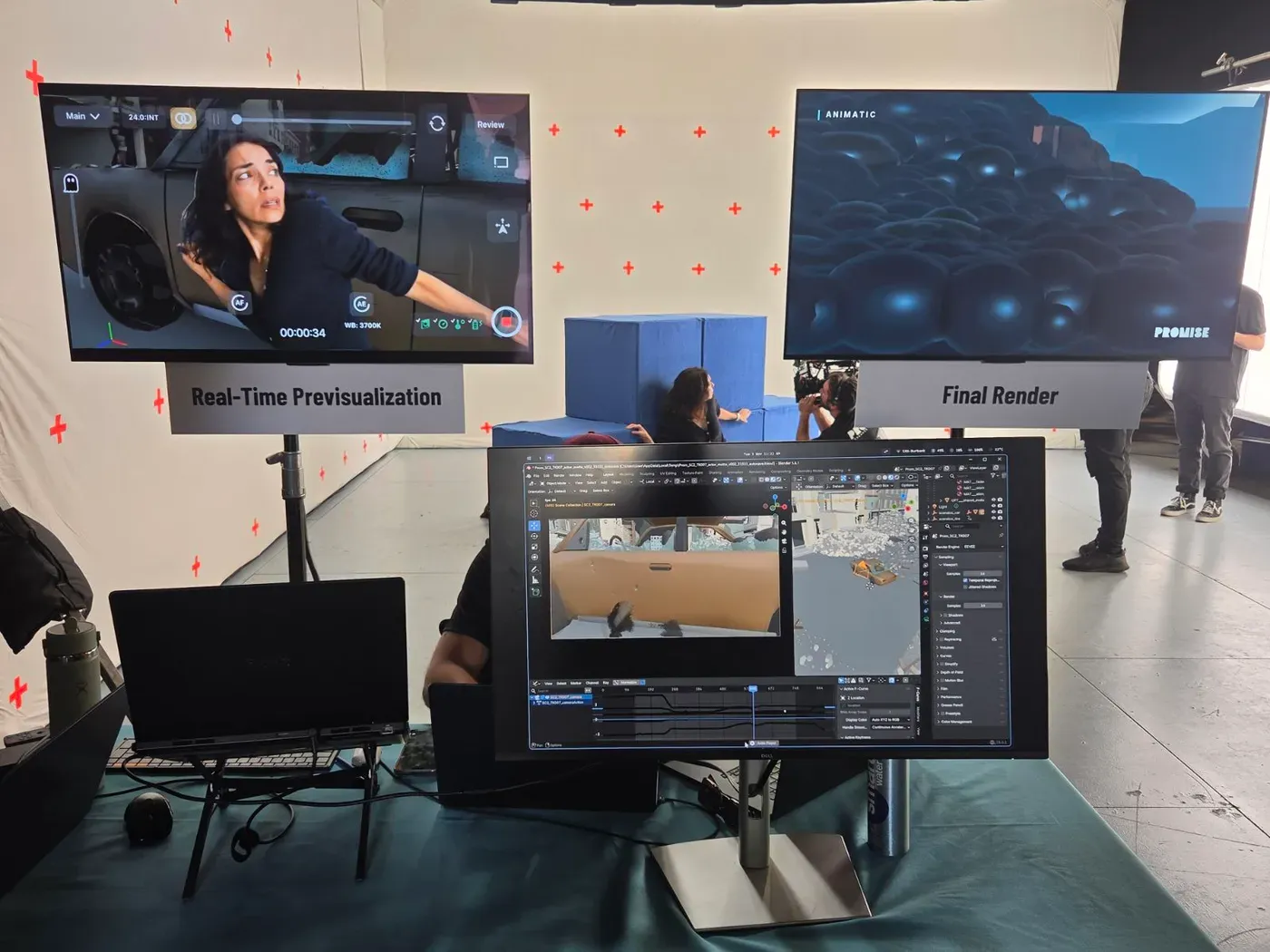
A revolutionary change is underway in the film industry as artificial intelligence (AI) begins to take its place on Hollywood sound stages. This innovation has been demonstrated on a Disney sound stage in Los Angeles, where a woman was positioned in front of a camera and surrounded by a "gray box, a small, neutral-colored space marked with crosshairs for precise positioning.
The gray box is a stark contrast to the traditional green or blue screens used for decades in filmmaking. These screens allow post-production crews to insert visual effects and backgrounds behind actors, but they can be prone to unwanted reflections and require constant adjustments when switching between shots. In contrast, the gray box provides a more versatile and controlled environment.
A camera was trained on the woman as she performed her actions, and almost instantaneously, AI rendered her in a convincing scene on screen. The image showed her standing on a cliff, with wind blowing through her hair, thanks in part to the sophisticated technology being employed. This marked a significant step forward in the use of AI on film sets.
The integration of AI into filmmaking is expected to streamline production processes and improve visual effects. By using AI to generate realistic backgrounds and environments, filmmakers can reduce the need for extensive post-production work and create more immersive experiences for audiences.
Filming in a gray box environment allows for more flexible shot arrangements compared to traditional settings. This flexibility is combined with the use of artificial intelligence to generate or assist in creating realistic backgrounds, resulting in faster post-production processes.
According to Promise Advanced Imagination, an entertainment studio that showcased its filming product during the Disney Accelerator Demo Day last week, setting up shots in gray boxes takes significantly less time than it does with green screen backgrounds. This reduced setup time allows crews to be more creative and focused on storytelling rather than being bogged down by tedious tasks.
Crews can capture multiple takes without the need for extensive reconfiguration, as everything remains consistent within the gray box environment. This enables directors to focus on the story and its creative aspects, rather than worrying about logistics such as moving equipment or adjusting lighting setups.
By leveraging AI tools to fill in backgrounds, replace objects, and adjust lighting conditions, post-production times can be further reduced, resulting in significant cost savings for productions.
As productions continue to incorporate AI tools into their workflows, a balance must be struck between leveraging technology and maintaining human creativity. While some environments are entirely computer-generated, most are still created by skilled 3D renderers and visual effects artists working alongside AI.
To ensure that productions retain their high-quality standards, AI is used to fill in backgrounds, allowing production companies to reduce costs without sacrificing scale or detail. This approach also enables them to invest less capital in producing pilots.
According to industry insiders, the creative process remains firmly rooted in human expertise, with traditional techniques and skills still playing a crucial role. Even as AI tools become increasingly prevalent, everything that goes into a project is carefully reviewed by experienced artists.
One concern surrounding the adoption of AI technology is its potential impact on jobs across various sectors, including acting, animation, writing, and set design. However, experts argue that these tools are designed to augment human capabilities rather than replace them.
Disney's innovation team has also weighed in on this issue, pointing out that AI-powered backgrounds simply streamline an existing process, freeing up crew members to focus on performances and direction while maintaining the core creative roles of directors, writers, and actors.
Disney's adoption of AI technology is part of its broader strategy to leverage emerging technologies and put them in the hands of its creators.
The goal is not to replace human artistry but to augment it, allowing artists and technicians to focus on what they do best, creating immersive stories.
At a recent demo day at Walt Disney Studios in Burbank, California, Promise CEO George Strompoulis outlined his company's four major components. These include the ability to produce high-quality features at a lower cost and timeline, as well as the Muse AI technology platform workflow software.
Promise has also established The Curious Refuge AI Filmmaking academy, which serves as a pipeline for top artists in the industry and aims to upscale existing film professionals. Additionally, the company operates The Generation Company, its AI visual effects business.
Disney's senior vice president of creative innovation, Rob Bredow, emphasizes that his team is not seeking to automate movie production with an AI button".
On a Disney studio sound stage, a woman is captured on camera crouching next to a car amidst explosions, while still standing in front of blue boxes.
She picks up a screwdriver from the floor, which appears as a mysterious scroll on screen, reminiscent of an action-adventure movie like Lara Croft's. The scene seamlessly blends real-world and virtual elements.
The technology is still in its early stages, but experts say it will require collaboration between filmmakers, creative technologists, and artists who are proficient in AI tools to achieve cinematic-quality results.
Facts based on reporting originally published by CNET.
You may republish this story, in full or in part, if you credit News Central Site and link to it (licence CC BY 4.0). Photos are not included.