Plymouth Colony Hosts Historic Harvest Feast in 1621
A rare moment of cooperation between the Wampanoag tribe and English colonists took place at the Plymouth Colony in 1621.
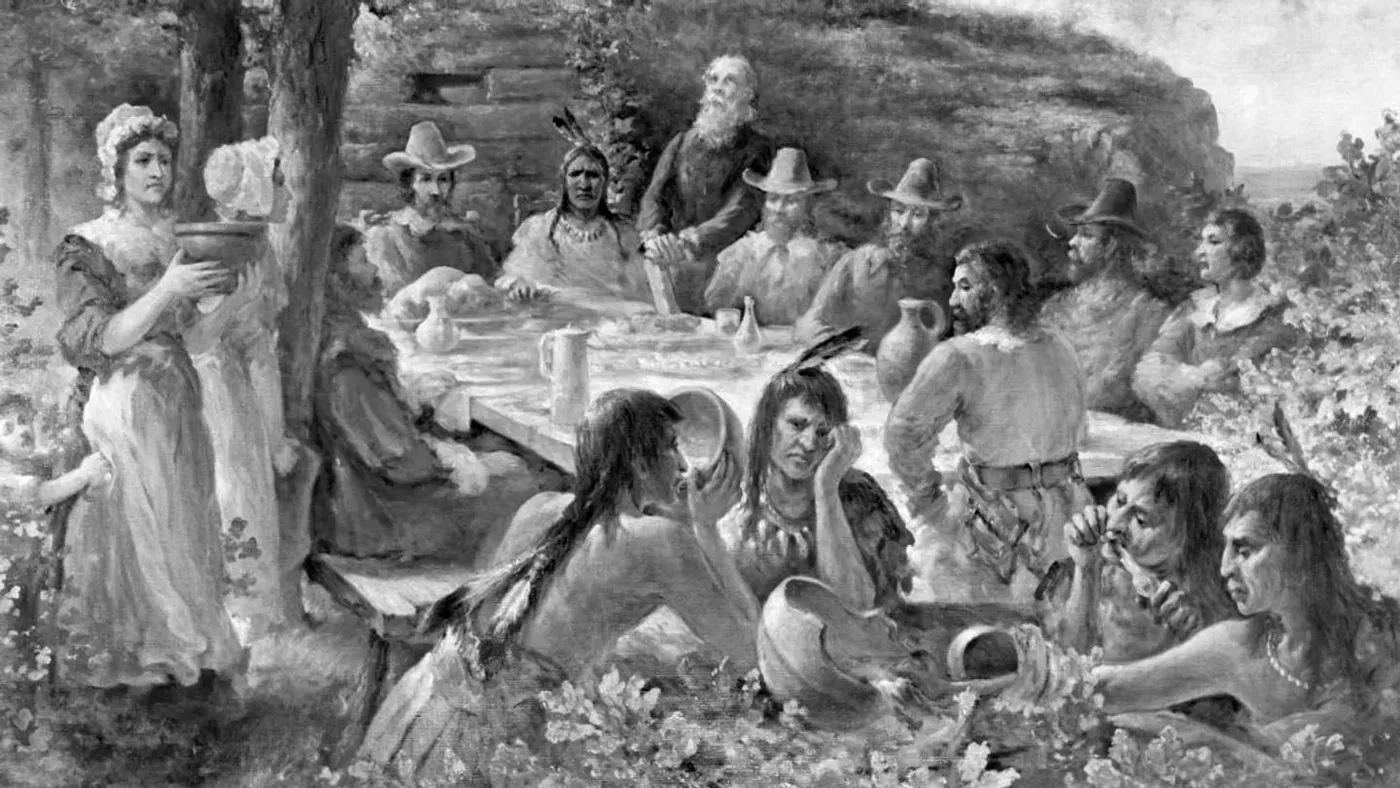
Plymouth Colony in Massachusetts played host to a historic gathering in the fall of 1621. Members of the Wampanoag tribe and several English colonists came together for a feast that marked an abundant harvest and a brief alliance between their communities.
The significance of this event has been grossly exaggerated over time, with many viewing it as the first Thanksgiving. However, neither Native Americans nor the Pilgrims could have predicted that this one-off meal would be immortalized in history books. The reality is that this occasion was more complex than a simple celebration of food and gratitude.
The feast was a rare moment of cooperation between two vastly different cultures. In 1621, tensions were running high as English colonists struggled to establish themselves in the New World. Yet, for one brief period, they put aside their differences with the Wampanoag tribe.
The first Thanksgiving is often romanticized as a harmonious celebration between European settlers and Native Americans. However, this simplistic view overlooks the complex history of the Wampanoag tribe's interactions with Europeans.
Prior to the Pilgrims' arrival in 1621, the Wampanoag had already encountered English colonists who brought devastating diseases that decimated their population. Additionally, some Wampanoag members were enslaved by these early European settlers.
The Wampanoag had also developed a unique relationship with the English language, having learned it from earlier encounters. By the time of the feast, they could communicate effectively in English, which facilitated dialogue between the two groups.
Despite initial reservations from tribal leaders, the peace treaty signed earlier that year laid the groundwork for this historic meal. The Wampanoag shared their expertise on hunting and planting techniques with the Pilgrims, significantly alleviating food shortages.
The three-day feast was a testament to the collaborative efforts of both groups, who came together to celebrate a bountiful harvest and newfound peace.
The three-day feast was a significant event in the early history of the Plymouth Colony, marking a moment of cooperation between the English settlers and the local Wampanoag tribe.
According to historical records, the gathering lasted for an extended period, with both groups coming together to celebrate a bountiful harvest and newfound peace. This collaboration is evident in Edward Winslow's account of the occasion, where he described the hospitality shown to their guests from the Wampanoag tribe, including their leader Massasoit.
The bond between the English and Native Americans was short-lived, however. Just 54 years after this initial meeting, tensions arose, leading to the dissolution of the treaty that had been formed. This event sparked King Philip's War, a conflict in which the English ultimately emerged victorious but at great cost.
Mass casualties were suffered by both sides during the war, and the Wampanoag lost control over their land and freedoms as a result. The defeat marked a significant turning point in the relationship between the European settlers and Native American tribes in the region.
While feasting was an important tradition for both groups, this particular Thanksgiving celebration did not become an annual event. It would take another century for the idea of a national holiday to emerge, with Abraham Lincoln's proclamation in 1863 marking the beginning of modern-day Thanksgiving celebrations.
The idea that the first Thanksgiving was a grand feast has been somewhat exaggerated over time.
This misconception may have arisen from the fact that both settlers and Native American tribes held feasts to commemorate significant events in their communities.
However, these gatherings were not necessarily annual traditions, but rather one-time celebrations to mark specific occasions.
In contrast, the 1621 harvest celebration at Plymouth Colony was more of a practical gathering than a festive occasion.
The food served during this meal would have been simple and straightforward, consisting mainly of what was readily available in the surrounding area.
Historical records suggest that wild fowl was the main course at the First Thanksgiving, contradicting the popular notion of a turkey-centric meal.
The presence of wild turkeys in the region is undeniable, but Plimoth Patuxet's Kathleen Walls believes they were not the stars of the show. Instead, the feast likely featured a variety of game birds, including swans and waterfowl.
Other foods that may have been served during the three-day celebration include cornbread, eels, lobsters, clams, mussels, and fish, thanks to Plymouth's proximity to the ocean. Farmed produce such as beans, pumpkins, and squashes would also have been available, as well as forest foods like nuts and berries.
In addition to these local delicacies, the settlers may have also enjoyed some of their own harvests, including turnips, carrots, and garlic. These vegetables were likely grown in the aftermath of learning agricultural techniques from the Wampanoag tribe.
The variety of foods available at the First Thanksgiving was shaped by the region's unique geography and the skills that the settlers acquired from their Native American neighbors. As a result, the meal would have been a true reflection of the area's resources and cultural exchange.
The Pilgrims' culinary skills were shaped by their limited resources and unfamiliarity with certain ingredients. Without butter, flour, or sugar, they couldn't produce elaborate baked goods like pies and pastries, which were staples in England.
Their diet also lacked potatoes, a staple crop in many parts of Europe, and cranberries, which weren't used to make sauce until later. The absence of these ingredients forced the Pilgrims to rely on simpler recipes that made use of readily available foods.
To prepare their main course, the Pilgrims stuffed birds with chunks of onion and herbs before either spit-roasting or boiling them, depending on their size. Some birds were also stuffed with shelled chestnuts as a filling.
Facts based on reporting originally published by Mental Floss.
You may republish this story, in full or in part, if you credit News Central Site and link to it (licence CC BY 4.0). Photos are not included.