Philadelphia Sees Over 65,000 Early Votes Ahead of Election Day
More than 12 million votes have been cast across the United States ahead of Election Day, with Philadelphia seeing a significant number of early voters.
In the lead-up to Election Day, more than 12 million votes have already been cast across the United States, with Philadelphia being one of the cities that has seen a significant number of early voters.
Over 65,000 people in Philadelphia have already cast their ballots, which is a notable figure given the city's status as a key battleground state.
The voting processes in Philadelphia have not escaped criticism from President Trump, who has been vocal about his concerns for more than a decade.
In an effort to get to the bottom of these preparations, a team from a partner organization is working with local officials to examine how they prepare for voting.
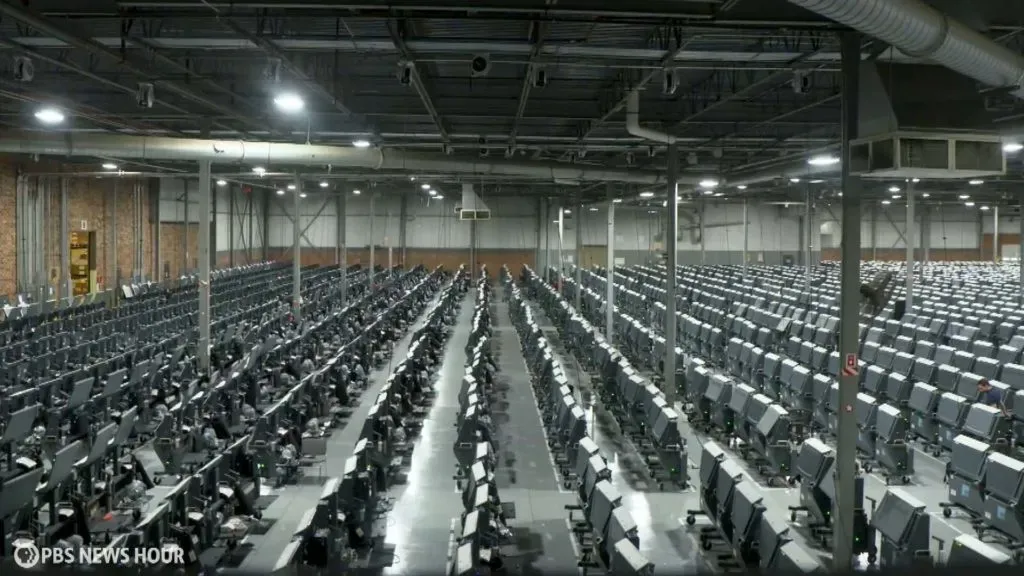
At a warehouse in Northeast Philadelphia, workers are busy setting up the equipment and materials needed for Election Day.
Philadelphia City Commissioner Seth Bluestein emphasizes that running elections in the city doesn't require a particular set of values, but rather American values. He believes that the work done by election officials is nonpartisan and focused on ensuring fair and accurate results.
This view is echoed by Lisa Deeley, another Philadelphia City Commissioner, who describes their role as "umpires" calling balls and strikes. They strive to remain impartial and ensure that every vote counts equally.
President Donald Trump has repeatedly singled out Philadelphia in his campaigns since 2016, often labeling it one of the most corrupt cities in the country. This rhetoric has had real-world consequences for election officials like Deeley and Bluestein, who have received death threats and harassment.
In 2020, tensions ran high as mail ballots were being counted, cutting into Trump's lead in Pennsylvania. Two days after the election, he lashed out at Philadelphia, along with Detroit, claiming they were among the most corrupt cities anywhere. His comments sparked a wave of protests outside the Convention Center where votes were being counted.
The aftermath of that election saw Deeley forced to leave her home and go into hiding in a hotel due to harassment from protesters on both sides. This experience was a stark reminder of the dangers posed by inflammatory rhetoric, according to Bluestein.
Trump's attacks on Philadelphia have continued even after his return to the White House, with him claiming without evidence that mail-in voting is rife with fraud. He has also pushed for federal legislation to overhaul elections, suggesting that the federal government should get involved in ensuring the integrity of elections in cities like Philadelphia.
Philadelphia's elections have been under scrutiny due to claims of widespread cheating, but officials say they have evidence to prove otherwise.
According to Seth Bluestein, Philadelphia's lead on election reform, the city has data that shows there is no massive cheating in its elections, and this can be seen literally in the numbers.
Mail-in voting has also been a topic of concern, with some questioning its safety and the likelihood of fraud. However, Lisa Deeley, a top official, assures that mail voting is safe and trusted.
Despite a few high-profile cases of fraud in Philadelphia, including one involving around four dozen votes, there has been no widespread documented fraud in a presidential general election.
Convincing local Republicans to trust the electoral process is a challenge for Bluestein, who has to counter claims made by national leaders that undermine confidence in the city's elections.
Building trust with local Republicans is key, says Bluestein, and it involves showing them the work being done to ensure fair and secure elections.
The Philadelphia Board of Elections has implemented measures to ensure accuracy in counting votes, a process that can be time-consuming but crucial to maintaining public trust.
According to officials, ballots are being processed carefully, and the count is not rushed for the sake of speed, with officials instead focusing on getting it right. This approach has been refined over the years, particularly since 2020 when election procedures were reviewed and improved.
As voters submit their mail-in ballots, they will be stored in a secure location until Election Day morning, when processing begins. Officials aim to complete the count by midday Wednesday, allowing for timely results and minimizing any potential disputes.
A growing concern for Philadelphia officials is the pressure being applied from Washington on voting procedures. President Trump has signed an executive order that would restrict mail-in voting, but it was blocked by the Supreme Court before taking effect in the midterm elections.
The same order instructs the attorney general to investigate state and local officials who issue ballots to ineligible individuals, a move that has left some officials uneasy about potential repercussions. However, they maintain that this is an unlikely threat, given the safeguards already in place.
Despite the increasing demands on their role, election officials are working diligently to ensure a smooth process, one that balances efficiency with accuracy and security. As one official noted, their job used to be relatively straightforward, but it has become more complex due to external pressures and concerns about potential repercussions for doing their job correctly.
Philadelphia's preparations for Election Day have been influenced by mixed messages from the president and his administration regarding federal agent involvement at polling places.
Pennsylvania law strictly prohibits officers or federal agents from being within 100 feet of polling areas, which suggests that any attempts to dispatch them on Election Day would be futile in Philadelphia.
The city's officials have acknowledged this reality and are instead focusing on developing contingency plans for potential issues that may arise. These plans have been crafted in collaboration with the law department to ensure a swift response to any problems.
Election officials like those in Philadelphia recognize the importance of anticipating every possible scenario, even if they seem unlikely. This approach is crucial given the mixed signals emanating from Washington.
The president's attacks on cities' elections infrastructure have sparked concerns about the long-term impact on public trust in the voting process. These criticisms are seen as both a distraction and a threat to the fundamental principles of democracy.
Philadelphia is gearing up for Election Day, with a significant number of poll workers already trained and ready to go. The city aims to have 8,000 volunteers in place, but currently has around 7,200.
To ensure the success of this effort, the Office of the Philadelphia City Commissioners is seeking willing participants who truly care about democracy and are committed to helping with election day operations. These individuals will play a crucial role in making sure that every voter has a smooth and trouble-free experience at the polls.
Back at the warehouse where voting machines are stored, hundreds of devices are being prepared for deployment to polling locations across the city. Once the polls close, the results from these machines will be transported back to the warehouse, where they will be combined and tallied on secure computers.
The city's election officials are taking steps to ensure that every voter has confidence in their system. This includes transferring vote counts from the voting machines to a separate computer via secure compact discs, which will then release the results to the public.
Facts based on reporting originally published by PBS NewsHour Politics.
You may republish this story, in full or in part, if you credit News Central Site and link to it (licence CC BY 4.0). Photos are not included.