Bull shark spotted at Great Sea Reef in northeast Fiji
A scuba diver witnessed a majestic bull shark in its natural habitat while exploring the Great Sea Reef in northeast Fiji.
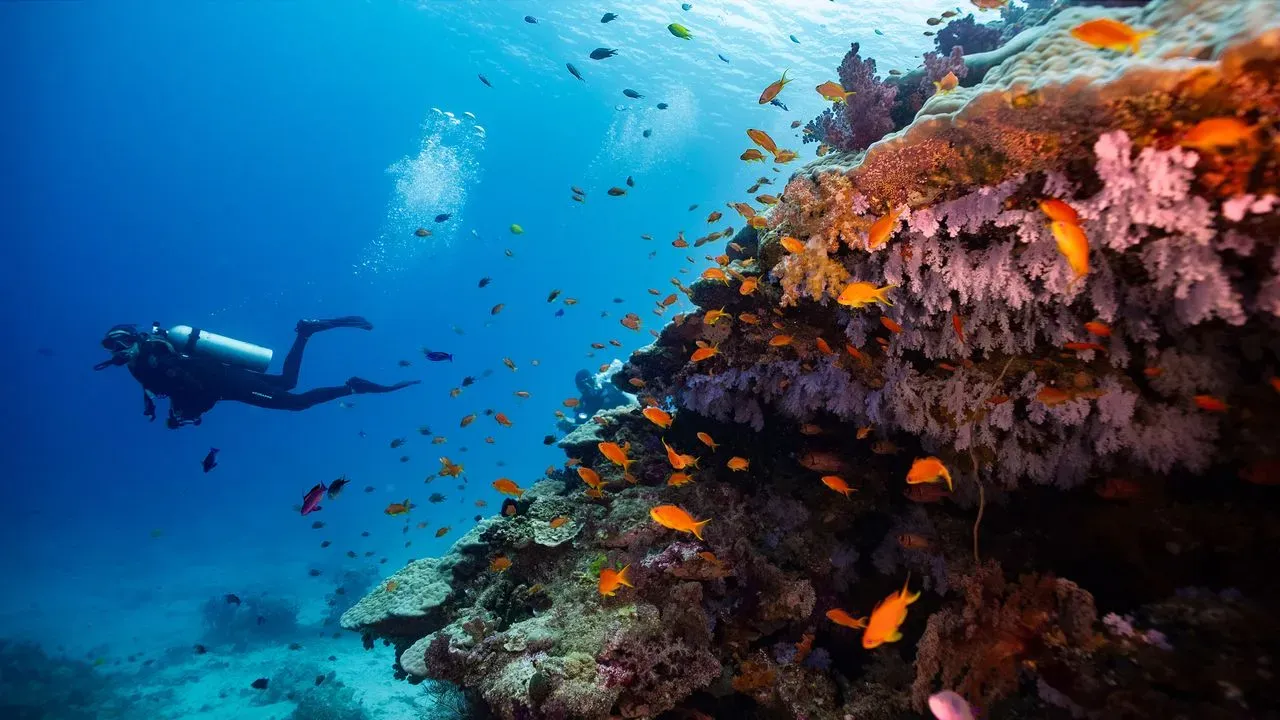
A scuba diver's dream come true: witnessing a majestic bull shark in its natural habitat. The creature emerged from the depths of the South Pacific Ocean in an instant, its imposing size and bulk evident even at 60 feet below.
Floating alongside the shark were two remora fish, their sleek bodies gliding effortlessly through the water as if guarding their larger companion. The bull shark itself moved with surprising speed, given its considerable girth, as it swam just above the sandy sea floor.
As the shark turned in the water, a wall of vibrant coral rose up from the depths to the right, a kaleidoscope of colors - neon green, milky orange, and soft pink - that seemed almost otherworldly. Meanwhile, deep water beckoned to the left, an endless expanse of blue that stretched out into the distance.
A fellow diver floated nearby, clad in a striking speckled camouflage wetsuit that blended seamlessly with the surrounding environment. His wild hair was visible above his mask, and he gave a nod of acknowledgement as he flattened the side of his hand against his head - a universal sign for one of the most coveted sightings in diving: a shark.
The sighting was all the more remarkable given the relatively unknown status of the Great Sea Reef, a 280-mile-long underwater paradise in northeast Fiji. This coral reef system is not only home to an astonishing array of marine life but also boasts a staggering three-quarters of all known coral species and over half of all recognized fish.
As a hub for conservation research, the Great Sea Reef is gaining recognition, with organizations such as PADI AWARE and the World Wildlife Fund launching initiatives to promote community-backed ocean conservation. In July 2026, a new partnership was announced to take this effort forward.
A groundbreaking collaboration between PADI AWARE and WWF is revolutionizing the way we approach marine conservation by harnessing the power of scuba diving communities worldwide.
The Global Shark & Ray Census project aims to collect vital data that can inform governments in Fiji and beyond about the creation of new Marine Protected Areas, a crucial step towards safeguarding coral reefs.
PADI AWARE's programs director Ian Campbell is driving this ambitious initiative forward by bringing together PADI's vast network of certified divers and dive centers with WWF's conservation efforts spanning over 100 countries.
As I explored the Great Sea Reef, I was struck by the unique opportunity for travelers to experience this ecosystem firsthand while contributing to a pioneering approach to coral reef protection.
My morning dive was filled with excitement when we spotted a lone bull shark, which I documented in my waterproof notebook with a simple yet satisfying "bull shark: 1.
The notes from that dive were just the beginning of the data collection process, and it was only when we returned to land that our logging efforts would truly begin.
The winding path leading to Nukubati resort was flanked by coconut trees whose angled heights seemed to stretch up towards the sky.
Opened in 1992 by Jenny Leewai and her Australian husband Peter Bourke, this Fijian resort has been a family affair for two generations.
Nestled on the shores of the Great Sea Reef, Nukubati is the only property located within the reef's boundaries, making it an ideal base for exploring the area.
After each dive, guests would return to the resort and be greeted by its tranquil atmosphere, complete with custom-ordered cane palm furniture and gleaming wooden floors that seemed to reflect the light of the sun.
The private bure where I stayed was a cozy haven, equipped with all the necessary amenities, including a hot shower that helped wash away the fatigue of the dive.
As I joined the others at the open-air lounge, nicknamed the pavilion, I couldn't help but notice the relaxed atmosphere that pervaded the resort.
Jenny and Lara were already seated on the couch, looking every bit the epitome of island elegance in their casual attire, with Jenny sporting a caftan and Champagne-colored pearls.
As we made our way back to shore after spotting those sharks, I took out my phone and logged the sighting on the PADI AWARE app.
It was quick and straightforward - just a few minutes of tapping through details like our location, activity, maximum depth, and the types of sharks we'd seen. We marked Fish Market as our dive site, recorded our underwater excursion as diving, noted that we hadn't gone below 60 feet, and identified the species we'd encountered.
The census has gained significant traction since its launch in April 2026, with over 212,000 people participating worldwide and submitting thousands of sightings.
These reports are then reviewed by PADI AWARE staff, who work closely with experts from the James Cook University Centre for Sustainable Tropical Fisheries and Aquaculture in Australia to ensure the accuracy of the data.
Researchers have already made use of this information - a scientific paper currently under review has incorporated some of the census findings. Moreover, images submitted through the app have helped confirm the presence of four shark and ray species in Vanuatu.
The great hammerhead shark is among those species, listed as Critically Endangered" on the IUCN Red List due to its impressive size - up to 20 feet long - and mysterious mating behaviors.
Fiji's Marine Protected Areas have proven to be a successful model for conservation, safeguarding reefs for both locals and travelers while providing new economic opportunities for communities.
Nukubati Resort stands out as an exemplary case of how tourism can positively impact the environment and local economies, often without visitors even realizing it at first. The resort has been a hub for sustainable practices and eco-friendly initiatives that benefit both the surrounding ecosystem and its guests.
During my stay at Nukubati, I had the privilege of witnessing multiple shark and ray species thriving in their natural habitat, free from human influence such as feeding or baiting. This was not an isolated incident; every single dive I went on featured these incredible creatures.
The statistics are certainly eye-opening, making diving on the Great Sea Reef an attractive option for both seasoned scuba enthusiasts and beginners alike. With options available for snorkelers, beginner divers, and advanced divers, there's something for everyone to enjoy in this unique marine environment.
As a PADI scuba diving instructor with extensive experience worldwide, Vincent was keenly aware of the reef's significance during our excursion. He pointed out that the absence of sharks on every dive was indeed remarkable, especially considering we were the only boat present at the site.
The Great Sea Reef holds a special place in the hearts and histories of local communities, who have revered it for generations through songs, stories, and cultural traditions. Its importance extends beyond its natural beauty to its role as a protector of their community's heritage.
Locals like Leone are now being recognized as traditional stakeholders in the GSR's future, a shift that acknowledges their deep connection to the reef.
Their unshakeable faith in the reef's importance is evident in the way they've nurtured Nukubati Island Resort, which has endured numerous challenges and still remains a tranquil hideaway for just 14 guests.
The property's resilience can be attributed to its strong family and community bonds, with all 100 staff members being local residents who have helped keep it afloat through thick and thin.
Nukubati has also been at the forefront of sustainability, having run on solar power since its inception in the 1990s, thanks to co-founder Peter's hand-engineered system.
The recognition of Nukubati as a PADI Eco Center in September 2026 marked a significant milestone for the resort and its operator, Great Sea Reef Divers, which demonstrated their commitment to conservation and sustainability.
This designation has allowed Leone and his team to contribute to global initiatives, such as logging shark and ray sightings in the new census, and encouraging visitors to participate in these efforts.
As they dive into the crystal-clear waters of the GSR, Leone's enthusiasm is palpable, with no regrets about their decision to prioritize conservation over commercial interests.
Facts based on reporting originally published by Conde Nast Traveler.
You may republish this story, in full or in part, if you credit News Central Site and link to it (licence CC BY 4.0). Photos are not included.